Disclosure: This post contains affiliate links. I may earn a small commission at no extra cost to you if you purchase through these links.
I put off buying a pressure washer for way too long. My driveway looked like a Jackson Pollock made entirely of oil stains and dead leaves, and my deck had seen better decades. Gas units always felt like overkill for what I needed, and the cheap electric ones I’d tried at friends’ places left me cold. Then I picked up the Worx WG606, and here’s what happened.
No sponsorship here. I bought this thing myself, used it on my driveway, deck, patio furniture, and yes — my car too. Let’s get into what the WG606 does well, where it falls short, and whether it’s worth your money.
Why Electric Pressure Washers Have Finally Caught Up
There used to be a real gap between electric and gas units. Gas dominated because electric just couldn’t touch the PSI. That’s changed a lot in the last few years.
The Death of the Gas Pressure Washer (For Most Homeowners)
Gas pressure washers are a pain, full stop. They sit in the garage all winter, and come spring, when you actually need one, it won’t start. Carburetor’s gummed up, you’re out of stabilized fuel, and you’ve burned 45 minutes troubleshooting before cleaning a single square foot.
Electric units plug in and go. That’s the entire pitch, and the WG606 leans into it hard.
What 2090 PSI Actually Means in Real Life See Today’s Deal on Amazon
The WG606 runs 1900 PSI continuous, 2090 PSI max. Pair that with a 1.2 GPM flow rate (max 1.4 GPM) and you land around 2,280 Cleaning Units — solid for home use. It won’t strip paint or etch concrete. Which is honestly what you want for most jobs around the house.
For context:
| Task | Recommended PSI | WG606 Suitable? |
|---|---|---|
| Car washing | 1200-1900 PSI | Yes (use 40-degree nozzle) |
| Deck cleaning | 1500-2000 PSI | Yes |
| Driveway/concrete | 2000-3000 PSI | Yes (with turbo nozzle) |
| Stripping paint | 2500+ PSI | Not ideal |
| Brick/retaining wall | 2000-2500 PSI | Works well with turbo |
| House siding | 1500-2000 PSI | Yes |
Anything in those first five rows, the WG606 handles fine. You won’t blast through a concrete stain in one pass, but with a few slow, overlapping sweeps and the turbo nozzle, you get results that would’ve taken an hour of scrubbing by hand.
Worx WG606 Specs and What They Mean for You
Motor and Power Output
The 13-amp motor is what separates this from the budget electric washers that cap out around 1500 PSI. At 13 amps and 120V you’re looking at roughly 1,560 watts — enough to hold pressure without constantly bogging down under load.
One thing I noticed: it doesn’t sputter or surge the way cheaper units do. Pressure stays steady through a whole cleaning session. That matters more than the peak PSI number on the box.
The Four-Nozzle System
This is where the WG606 earns its money. Four quick-connect nozzles:
Turbo Nozzle — The workhorse. Fires a spinning single-stream jet that covers more area while keeping pressure up. Use it on concrete, brick, anything with stubborn grime. It actually spins fast enough to widen the cleaning path without losing pressure at the tip.
25-Degree Nozzle — The everyday one. I used this for maybe 80% of the job. Decent balance of pressure and spread.
40-Degree Nozzle — The gentle option. Car paint, soft wood, vinyl siding — anywhere you don’t want to risk damage. The “go slow” nozzle, and it does its job.
Soap Nozzle — Low pressure, pulls from the onboard soap tank. Foam your target, let it sit, swap nozzles to rinse. Primes quickly, no fuss.
Pro Tip: Nozzle changes are tool-free with the universal quick-connect adapter. Takes about two seconds once you get the motion down — swapping mid-job stops being annoying pretty fast.
Onboard Soap Tank
Small, but it does the job. Not enough for a massive project, but for a car wash or a stretch of siding, it’s fine. The suction draws soap on its own when you’re on the soap nozzle — no extra fiddling.
Build Quality and Portability See Today’s Deal on Amazon
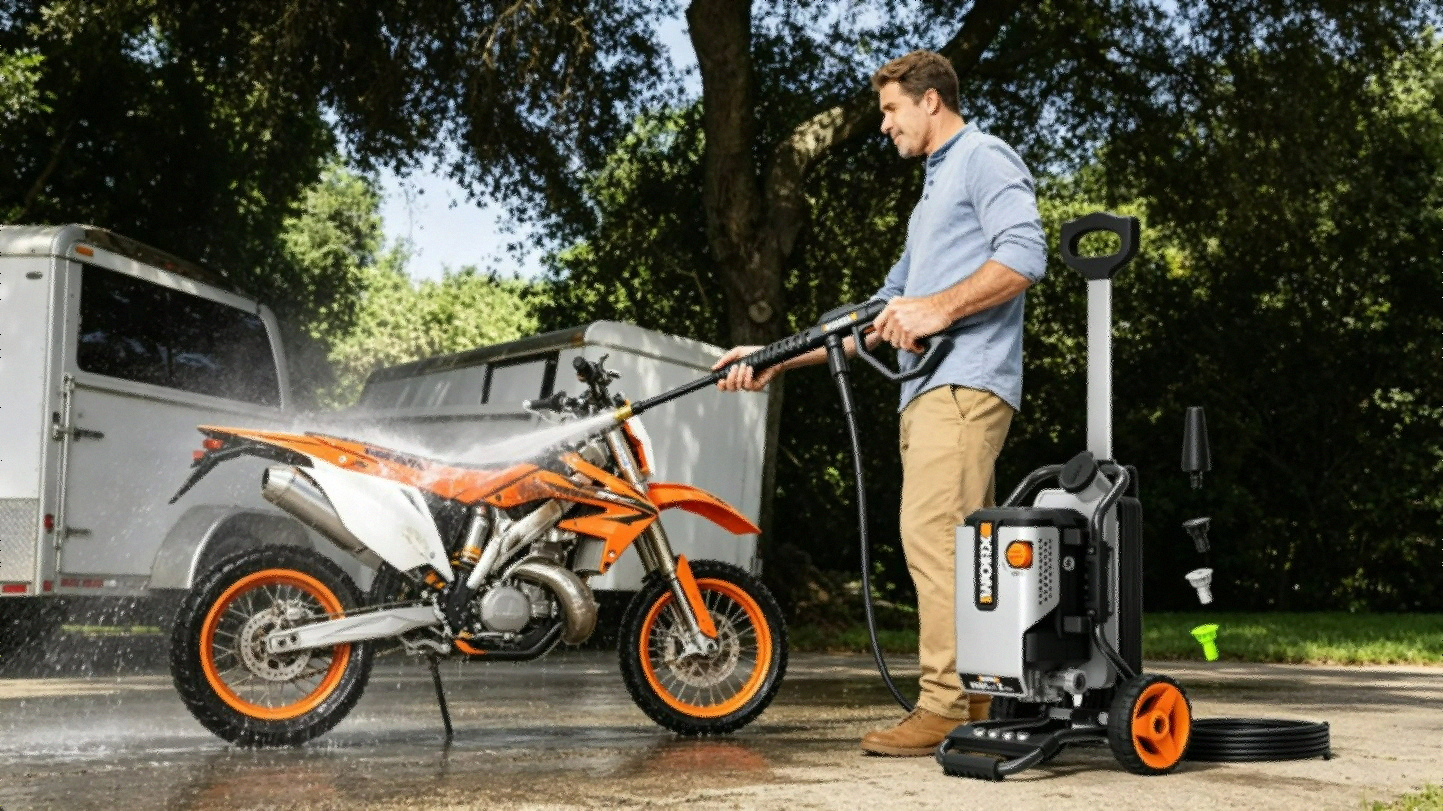
11.5 lbs. I’ve carried heavier backpacks. Two rugged wheels and a telescoping handle make it easy to move around the yard, even over gravel or uneven grass.
Worth calling out the handle specifically. Extended, it pulls comfortably. Collapsed, the whole thing stores in a surprisingly small footprint — mine lives in the hall closet without complaint.
But — and this one’s real — the handle mechanism has a known quality control problem. Some units ship with a handle that won’t stay extended. If that happens, contact Worx customer service right away. The replacement process is easy enough, but annoying if you draw a bad unit out of the box.
Hose and Cord Length
25-foot hose, 35-foot cord. That gives you real range from an outdoor outlet — enough to cover a whole car or a good chunk of driveway without dragging the unit around. Bigger decks or long driveways, you’ll be repositioning, but the thing’s light enough that it’s not a big deal.
The hose is the one part I’d change. Handles pressure fine, no leaks, but it’s stiff — worse in cold weather. A rubber hose would feel better in hand but add weight, and they clearly picked portability over that. I’d probably have made the same call.
Real-World Performance: What I Actually Cleaned
Driveway and Concrete
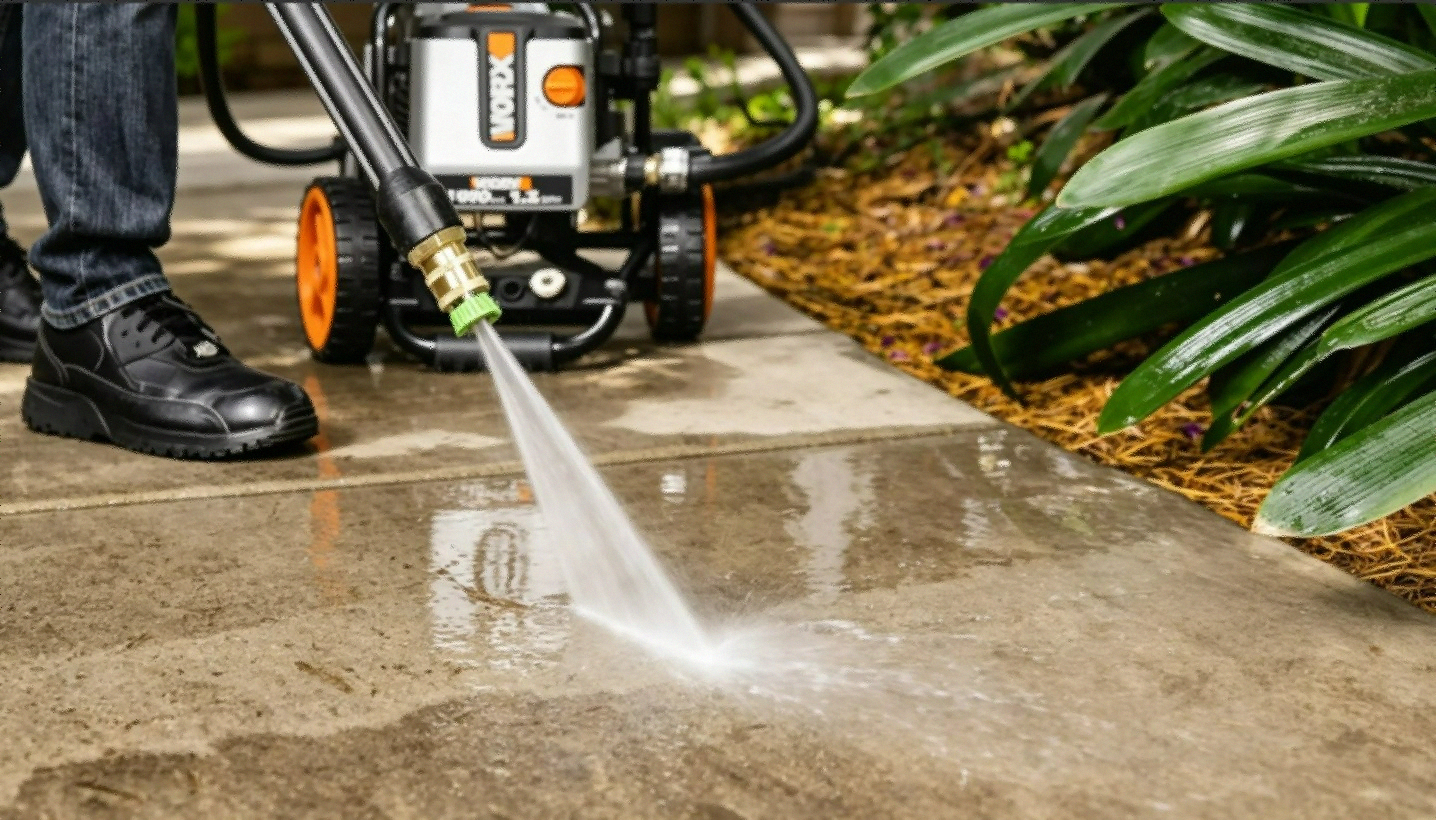
This is where it impressed me most. My driveway had a year’s worth of tire marks, oil drips, general grime. Turbo nozzle, slow overlapping passes, and the concrete went from embarrassing to clean. Not “brand new” — that needs a commercial unit or a surface cleaner attachment — but “acceptable suburban driveway,” without breaking a sweat.
On brick, the turbo nozzle is excellent. A previous owner of my house had a brick retaining wall gone almost entirely green with moss and algae. Three sessions in, it’s back to looking like brick.
Deck Cleaning
25-degree nozzle on my pressure-treated wood deck. Good results — gray, weathered wood came back to its natural tone where the wood underneath was still sound. I kept the nozzle moving, stayed around 18 inches off the surface, so I wasn’t raising the grain too aggressively.
Watch Out: On wood, never park the nozzle in one spot. Keep the wand moving constantly. A stationary nozzle will damage even pressure-treated wood at this PSI.
Car Washing
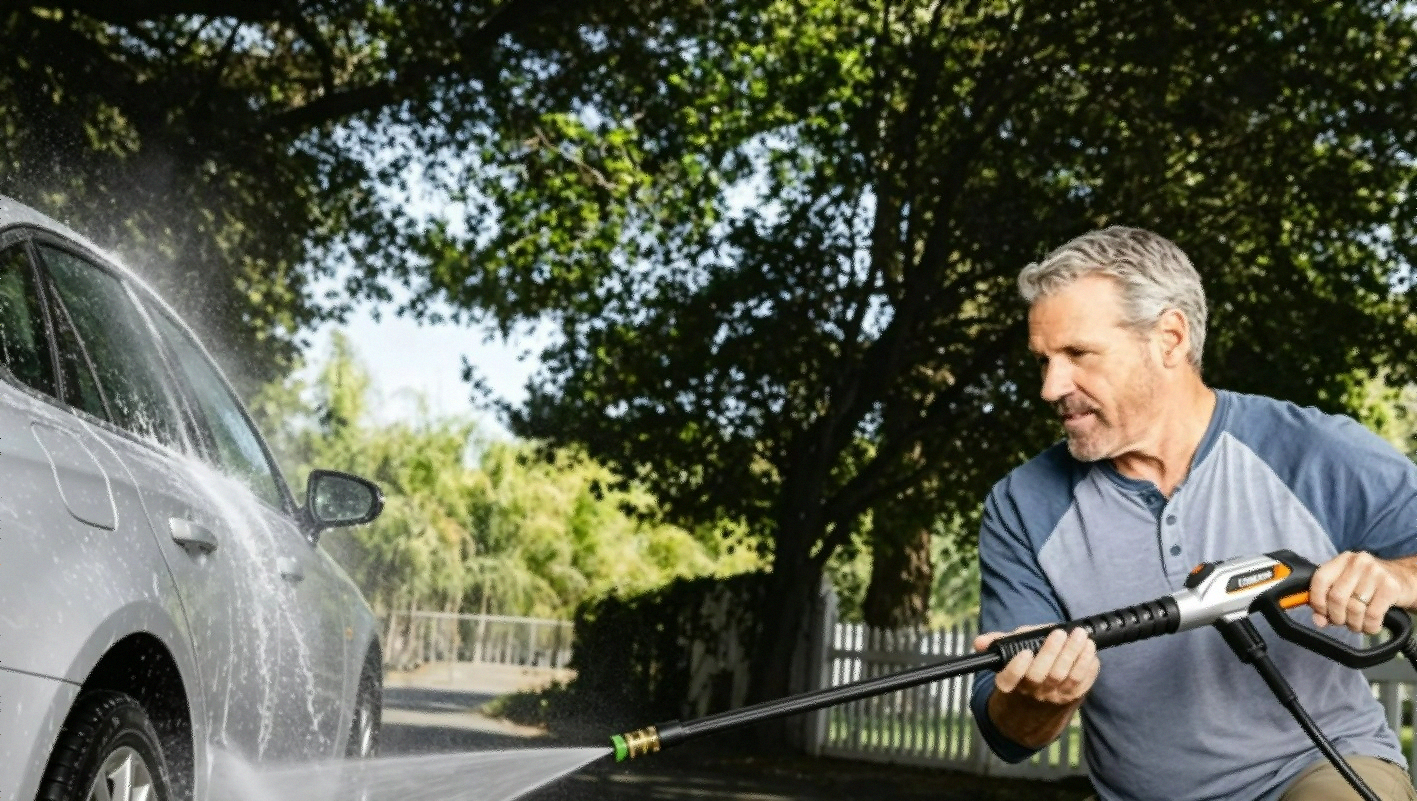
40-degree nozzle, 18-24 inches off the surface, works fine. Wouldn’t call it a dedicated car-wash machine — if that’s your main use, a lower-PSI dedicated unit might suit you better — but it gets there. Soap nozzle, then a 40-degree rinse, is a legit two-step wash that leaves the car clean.
Patio Furniture and Outdoor Cushion Frames
This one surprised me. Metal and resin furniture cleaned up fast. The 25-degree nozzle blew through a full summer of mildew and pollen in about 20 minutes for six chairs and a table.
Worx WG606 vs. the Competition
Since I’ve already covered a few other pressure washers on this blog, here’s how the WG606 lines up:
Related Post: DeWalt DXPW3300-S Review — 3300 PSI Gas Pressure Washer
Related Post: EGO HPW3200 Pressure Washer Review
| Model | PSI | Power | Weight | Price Range | Best For |
|---|---|---|---|---|---|
| Worx WG606 | 2090 max | 13A electric | 11.5 lbs | ~$230 | Light-medium residential |
| DeWalt DXPW3300-S | 3300 | Gas | ~70 lbs | ~$400+ | Heavy residential/semi-pro |
| EGO HPW3200 | 3200 max | Battery | ~68 lbs | ~$500+ | Cordless heavy-duty |
| Westinghouse ePX3500 | 2500 max | Electric | ~19 lbs | ~$170 | Budget electric upgrade |
The WG606’s lane is pretty clear: light, plug-and-play, easy to tuck away, capable enough for normal homeowner stuff. If you need to strip paint, clean commercial-scale surfaces, or do serious driveway restoration, go gas or heavy-duty battery instead.
Related Post: DeWalt vs Simpson vs Westinghouse Pressure Washer Comparison
What Actual Owners Are Saying See Today’s Deal on Amazon
Customer feedback tracks pretty closely with what I found. A few things stood out in the verified reviews.
Longtime users like the turbo head — the spinning mechanism really does cover more ground at the same PSI compared to a fixed nozzle. One reviewer cleaned a 50-foot deck and a 45-foot brick retaining wall with it, then bought a second unit after moving.
First-timers tend to be pleasantly surprised. The learning curve is basically nothing: hook up water, plug in, turn the dial.
The recurring complaints are the stiff hose (fair) and the occasional handle issue. One reviewer mentioned a broken cord holder right out of the box — frustrating, though Worx does have a return process for it.
The “Not Worx Quality” comment from one verified buyer is worth flagging. They own the rest of the Worx outdoor lineup and felt this one fell short of that standard. If you’re a Worx loyalist expecting the same fit-and-finish as their cordless tools, dial back your expectations a notch. It works fine, the engineering’s sound — but some of the plastic feels a step down from their other gear.
Storage and Maintenance
Genuinely one of the strong points here. Everything stores on the unit:
- The wand has its own onboard slot
- All four nozzles clip into dedicated onboard storage
- The cord wraps around an integrated cord-wrap on the handle
- The handle collapses down for compact storage
Setup is about 90 seconds. Breakdown’s about the same. That’s why people actually use these things instead of letting them gather dust in the garage.
Maintenance-wise: run clean water through after using soap, check the nozzle o-rings now and then, and keep it somewhere that won’t freeze. If you’re somewhere with real winters, bring it inside once temps drop, or the pump pays for it.
What I’d Tell My Past Self
If you’re on the fence between this and a gas unit, think about how often you’ll actually use it. Gas washers sit unused 90% of the time because starting them is a real psychological barrier. Electric units get used because plugging something in takes no effort at all.
I’ve used the WG606 more in three months than I used my neighbor’s gas washer in two years of borrowing it for “big jobs.” Accessibility wins more often than raw power does.
If you already own something like the DeWalt DXPW3400 and use it regularly, this isn’t an upgrade — it’s a step down in power. But if you’re going from nothing to something, the WG606 is a genuinely capable tool at a fair price.
The stiff hose bugs me. The handle quality is hit or miss. Neither one makes me regret buying it. It does what it’s supposed to, it’s easy to use, and it fits in my closet.
Frequently Asked Questions
Can the Worx WG606 be used on a car? Yes, with the 40-degree nozzle held 18-24 inches from the surface. Skip the turbo nozzle on car paint — too aggressive. The soap nozzle works well for foaming before rinsing.
Is 2090 PSI enough for a driveway? For regular driveway upkeep — dirt, algae, tire marks — yes. For heavy oil stains or a full restoration job, you’ll want 2500+ PSI. The turbo nozzle helps squeeze out more effective pressure.
How does the soap tank work? It draws automatically once you’re on the soap nozzle (the lowest-pressure one). Fill the tank, attach the nozzle, and the machine handles the rest — no extra switches to flip.
Does it work with Hydroshot accessories? Some are compatible through the quick-connect system, not all. Check Worx’s compatibility chart for your specific accessory before buying.
What’s the warranty? Worx offers a manufacturer’s warranty on the WG606. Specifics can be requested through Amazon customer service or directly via Worx’s website. Amazon also offers a standard 30-day return window.
Final Verdict
The Worx WG606 Electric Pressure Washer is a solid buy for the average homeowner who wants something capable, portable, and easy to live with. It runs $229.99 — not the cheapest electric option out there, but the feature set (four nozzles, onboard soap tank, 13-amp motor, telescoping handle) earns the premium over the budget stuff.
Buy it if: you want plug-and-play simplicity, you’re cleaning cars, decks, driveways, and siding, and closet space matters.
Skip it if: you need serious power for commercial-scale jobs or frequent paint stripping, or you’re a die-hard Worx fan expecting top-shelf fit-and-finish across the board.
It won’t make your jaw drop. It’ll just quietly do the job every time you plug it in.