Let me start with the thing that’s going to upset some people. After 8 months and probably 60+ cleaning sessions with the EGO HPW3200, I sold my Honda gas pressure washer last weekend. The one I bought for $549 three years ago, babied through every oil change, swore I’d never give up. Gone. Some guy off Craigslist gave me $280 and drove away with it.
The EGO does everything I used the Honda for, with zero gas fumes, zero pull-start frustration, zero “oh great I forgot to add stabilizer before winter and now the carb is gummed up” springtime drama. It’s not a perfect replacement — I’ll get into that — but the gap between cordless and gas has finally closed enough that for my use case (van washing, deck cleaning, occasional driveway blasting), the gas machine made no sense anymore.
This is going to be a long review because there’s a lot to say. If you’re in a hurry, scroll to the verdict section. But the details matter here, especially if you’re spending $800+ on something you want to last.
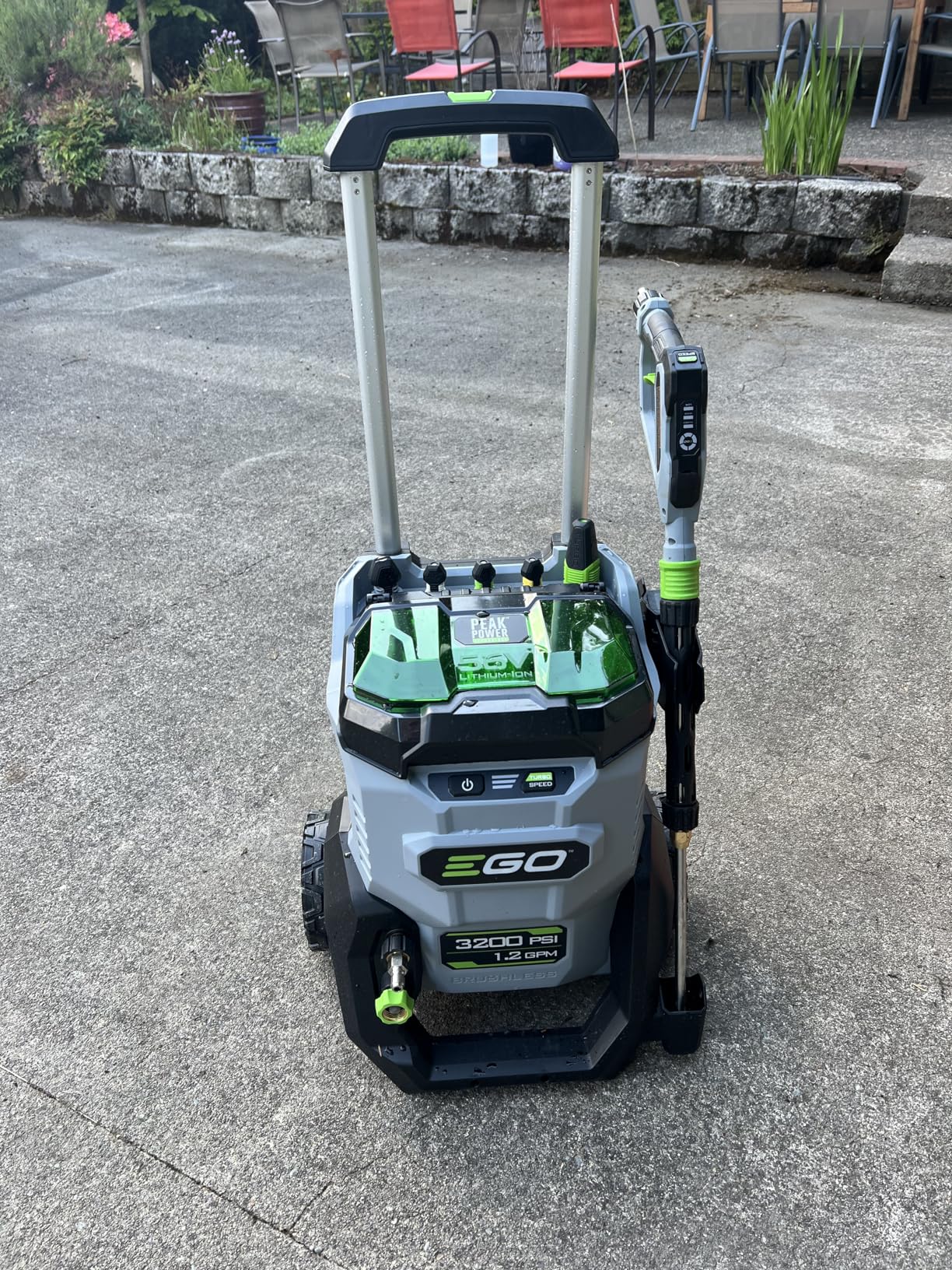
Table of Contents
Open Table of Contents
- Why I Even Considered a Battery-Powered Pressure Washer
- What’s Actually in the Box
- The Peak Power Technology Thing
- The Three Power Modes Explained
- Real Performance Testing After 8 Months
- Comparison: EGO HPW3200 vs Gas Pressure Washers in This Price Range
- The Battery Ecosystem Advantage
- What Annoys Me About the EGO HPW3200
- Setup Tips Nobody Tells You
- Who Should and Shouldn’t Buy This
- Long-Term Durability After 8 Months
- Some Questions Worth Answering
- External Resources Worth Checking
Why I Even Considered a Battery-Powered Pressure Washer
Quick context for anyone new to my stuff: I live full-time in a converted Sprinter van. I write product reviews, I work seasonally for the Forest Service, I park a lot of places where gas-powered equipment isn’t allowed or isn’t practical. Campgrounds with quiet hours. Public lands with fire restrictions. National forest dispersed sites where you really don’t want to be the person running a gas engine at 7 AM.
My old Honda pressure washer worked great when I had a driveway to wheel it onto. Living mobile, it was a constant headache. I had to drain it before every move. Gas would slosh in the tank. The pull cord required 25 feet of clear space to operate safely. I once had a campground host walk over and ask me to shut it off because it was scaring the birds at a state park.
I needed something quieter, lighter, that didn’t run on a fuel I had to source and store separately. Cordless tools were finally getting to a power level where they could compete with gas, so I started shopping.
The EGO HPW3200 kept coming up in my research for one reason: 3200 PSI is the highest peak pressure of any battery-powered pressure washer on the consumer market right now. Most of the competitors top out at 1800-2200 PSI. The EGO uses what they call Peak Power technology, which combines two 56V batteries to deliver gas-equivalent output.
I paid $849 for the kit (washer + 2x 6.0Ah batteries + charger) in September. Here’s the current Amazon listing if you want to check today’s pricing: EGO HPW3200 on Amazon
(Yeah it’s an affiliate link, yeah I get a small cut if you buy through it, no it doesn’t change what I’m saying. I bought my own. Full disclosure at the bottom.)
What’s Actually in the Box
The kit version comes with the pressure washer base unit, two 6.0Ah 56V ARC Lithium batteries, a dual-port charger, a high-pressure hose (25 feet), a pressure washer gun, a wand lance, an extended lance attachment, a foam cannon, a stainless steel utility wand, a siphon hose for drawing water from a bucket or other source, a filter screen for the inlet, and quick-connect fittings.
That’s a substantial accessory package. Most gas pressure washers in this price range come with the unit, the gun, the hose, and maybe two nozzle tips. The EGO includes the foam cannon (a $40-60 accessory if bought separately) and the siphon hose (critical for van life — more on this), and the variety of wand attachments covers basically every cleaning scenario I’ve encountered.
Build quality on initial impression was significantly better than I expected. The frame is metal where it matters (handle, axle, mounting points) and reinforced plastic elsewhere. The wheels are real rubber with metal hubs, not the hard plastic disks you get on cheaper units. The hose is flexible without being limp, which means it doesn’t kink every time you adjust your stance.
The two batteries lock into bays on the back of the unit. Quick to install, quick to remove. You can run the unit on a single battery in a pinch (at reduced power), but full 3200 PSI requires both batteries installed.
The Peak Power Technology Thing
Let me explain what Peak Power actually does because the marketing copy is vague.
A standard 56V battery delivers a certain wattage. To get higher output, you either need higher voltage or higher current. EGO’s Peak Power system parallels two 56V batteries to deliver double the current capacity at the same 56V, which lets the motor pull more wattage than a single battery could supply.
In practical terms: with one battery installed, the HPW3200 maxes out around 2200 PSI in High mode. With both batteries installed, it hits the full 3200 PSI peak in Turbo mode. The difference is noticeable. 2200 PSI cleans light grime fine; 3200 PSI removes stuck-on bug residue from highway driving without needing to scrub.
This also means the runtime calculation is different than you’d expect. Two 6.0Ah batteries running in parallel give you the runtime of a single 6.0Ah battery — they discharge together, not sequentially. The 60-minute runtime EGO claims is realistic only in ECO mode. In Turbo mode, expect 15-20 minutes of continuous use. In High mode, about 35-40 minutes.
For most cleaning jobs you’re not running the trigger continuously anyway — you spray, you reposition, you spray again. Real-world runtime on a typical session for me runs 45-90 minutes of total session time even in Turbo mode, with maybe half of that being active trigger time.
The Three Power Modes Explained
The HPW3200 has three modes selected via a button on the wand’s integrated display. Here’s what each one actually does:
ECO Mode runs the motor at lower wattage. Output is roughly 1900-2100 PSI. Maximum runtime. Use this for car washing, gentle deck cleaning, and anything where you don’t need to blast away stuck-on grime. Battery lasts ages in this mode.
High Mode runs at intermediate wattage. Output around 2600-2800 PSI. The mode I use most often. Good balance of cleaning power and runtime. Adequate for almost everything residential.
Turbo Mode runs the motor at maximum wattage, peaking at 3200 PSI. Battery drains noticeably faster. Use this for the worst grime: highway bug residue on the front of the van, oil stains on concrete, heavy moss on a deck.
You can switch modes mid-session without stopping. Press the button on the wand display, wait half a second, and the new mode engages on the next trigger pull. Smart integration.
Real Performance Testing After 8 Months
Let me get specific about what I’ve used this thing on, because broad claims like “cleans great” tell you nothing.
Washing the Van Exterior
This is my most frequent use. 24-foot Sprinter, exterior wash takes about 20-25 minutes of total session time. I use ECO mode for the pre-rinse, switch to High for the soap application via foam cannon, then back to ECO for the final rinse. Results are easily on par with what I got from the Honda gas unit.
The foam cannon attachment deserves special mention. It produces dense, clinging foam that actually stays on vertical surfaces long enough to break down dirt. Cheaper pressure washer foam cannons just dribble watery soap. This one creates the thick foam you see in the professional detailing videos.
Cleaning the Wheels
3200 PSI in Turbo mode handles brake dust and road tar that I couldn’t get off with hand washing. Stand back about 18 inches, use the medium-angle nozzle, work in sections. Done in 5 minutes per wheel.
Driveway and Patio Cleaning
I park at my parents’ place every few months for laundry and resupply, and I help them clean the driveway as part of the deal. Concrete with 6+ months of accumulated grime: the HPW3200 in Turbo mode with the rotating turbo nozzle (not included, $25 separate purchase, worth it) strips it back to bare concrete. Took about 90 minutes total, used both batteries down to about 15%.
For comparison, my old Honda would have done it in 70 minutes. The EGO is slower because of the lower flow rate (1.2 GPM vs the Honda’s 2.5 GPM), not the pressure. PSI strips grime; GPM rinses it away.
Deck Cleaning
3200 PSI is actually too much for most deck wood. I use ECO mode with the 40-degree nozzle, which keeps the pressure around 1500 PSI at the surface. Strips dirt and algae without etching the wood grain. Standard residential deck took about 2 hours including soap application.
Vehicle Wash on the Road
This is where the siphon hose justifies its inclusion. At dispersed camping sites without water hookups, I can run the pressure washer from a 5-gallon bucket of water. The siphon hose draws water from any open source. Sure, 5 gallons doesn’t go very far at 1.2 GPM (you’ve got about 4 minutes of trigger time before you’re dry), but it’s enough for a quick rinse of one section at a time, refilling between passes. Try doing that with a gas unit that needs constant pressurized water input.
Indoor/Garage Use
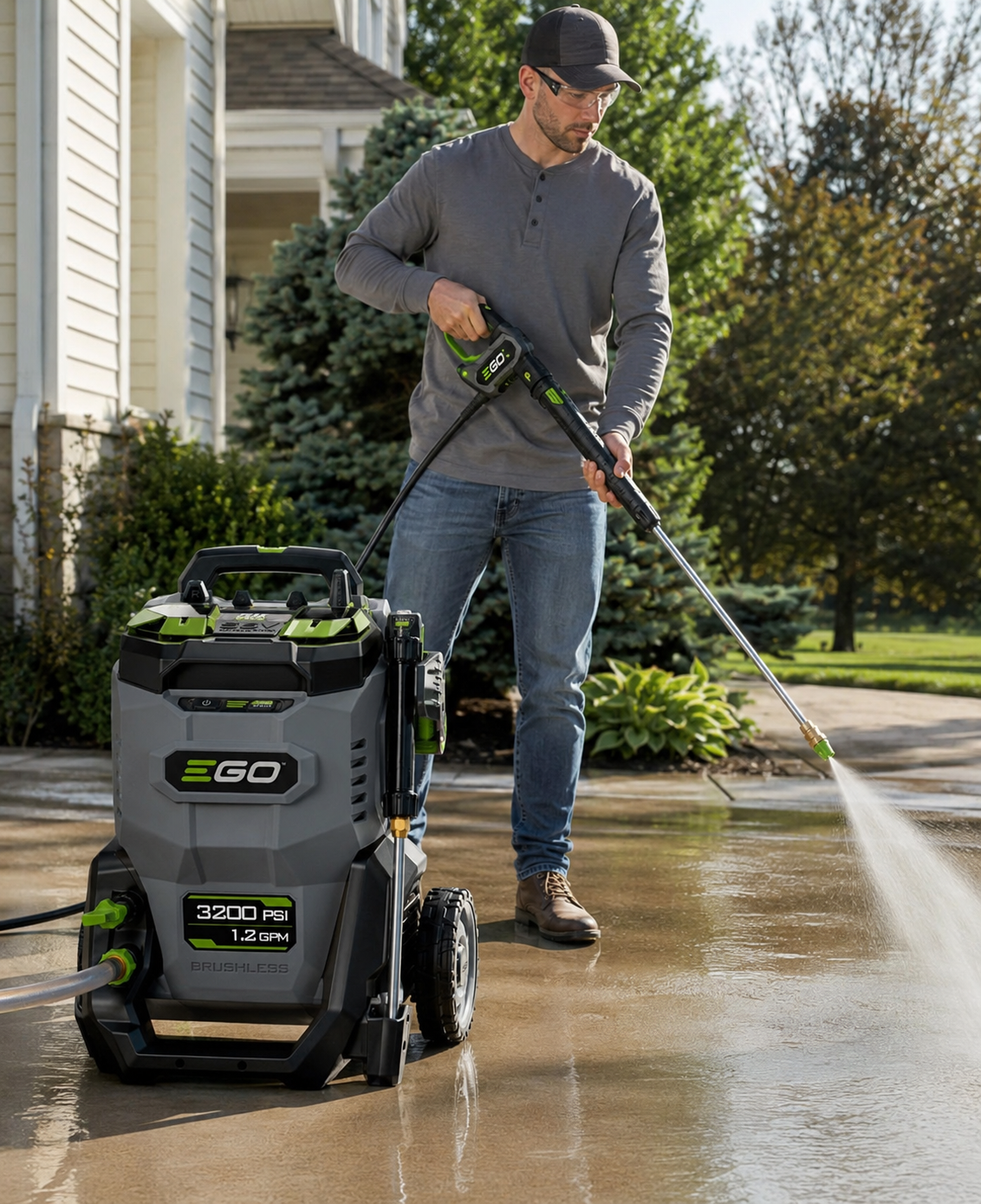
This is the killer feature that made me sell the gas unit. The EGO produces zero emissions. I can use it inside the garage at my parents’ place, in covered RV bays at campgrounds, in my van’s open side door without poisoning myself. Try that with a gas engine.
Noise level is also dramatically lower. The Honda was 95+ dB at 3 feet — actual hearing protection required. The EGO measures about 78 dB at 3 feet — annoying but not damaging. I can have a normal conversation while it’s running.
Comparison: EGO HPW3200 vs Gas Pressure Washers in This Price Range
I get asked this constantly so here’s the direct comparison:
| Factor | EGO HPW3200 (Kit $849) | Comparable Gas Unit ($600-800) |
|---|---|---|
| Max Pressure | 3200 PSI | 3200 PSI |
| Flow Rate | 1.2 GPM (2.0 GPM rinse) | 2.5-2.8 GPM |
| Runtime | 15-60 min per charge | Unlimited with fuel |
| Maintenance | None | Oil changes, carb cleaning, fuel stabilizer |
| Noise (dB at 3ft) | ~78 | ~95 |
| Emissions | Zero | Significant |
| Indoor Use | Yes | No (CO poisoning risk) |
| Initial Setup | 2 minutes | 5-10 minutes |
| Off-Season Storage | Easy | Drain fuel, fog cylinder, etc. |
| Cold Weather Start | Reliable | Often problematic below 40°F |
| Weight | 36 lbs | 60-80 lbs |
| Warranty | 5 yr tool, 3 yr battery | 1-3 years typical |
The big honest tradeoffs: lower flow rate means slower cleaning of large areas, and the per-session runtime limit means battery-intensive jobs require multiple charging cycles or additional batteries. Everything else, the EGO wins.
If your primary use is hours of continuous heavy-duty commercial-style cleaning, gas still wins on pure throughput. For everyone else — homeowners, DIYers, mobile users, anyone who values not poisoning themselves — battery has caught up.
The Battery Ecosystem Advantage
This is the part of the EGO value proposition that most reviews undersell.
The 56V ARC Lithium batteries are shared across the entire EGO Power+ ecosystem. The two batteries that came with my pressure washer also power my EGO chainsaw, my friend’s EGO leaf blower, another friend’s EGO mower. If you already own EGO tools, the HPW3200 is partially “free” in the sense that your existing battery investment carries over.
If you don’t own any EGO tools yet, you’re committing to a battery platform with this purchase. That’s a real consideration. Once you have $300 in batteries, you’re financially incentivized to stay with EGO for future cordless tool purchases. Some people see this as lock-in (negative); others see it as ecosystem consolidation (positive). I’m in the second camp. It means one charger, one battery type, one set of replacements over time.
The warranty matters here too. 5 years on the tool, 3 years on batteries. That’s substantially longer than most cordless power tool warranties. Greenworks gives you 4 years. DeWalt 3 years. Ryobi 3 years. EGO is playing the long game on durability claims, which suggests they believe the products will hold up.
What Annoys Me About the EGO HPW3200
The 1.2 GPM flow rate is the biggest limitation. Gas pressure washers move more water, and water volume is what physically transports loosened grime off the surface you’re cleaning. With the EGO, you spend more time rinsing because the rinse is slower. The 2.0 GPM mode helps but only applies with specific nozzle attachments.
Battery drain in Turbo mode is significant. Real-world Turbo runtime is closer to 15-18 minutes than the advertised numbers suggest. If you have a big Turbo-mode job, plan to charge mid-session or buy extra batteries.
The integrated wand display is gimmicky. Yes, it shows battery percentage and current mode. No, you don’t actually need this. A simple LED would have done the same job at lower cost. Mine occasionally goes blank for no apparent reason — it always comes back, but it’s a sign of complexity that didn’t need to exist.
The foam cannon soap knob is cheap plastic. Mine started slipping at the threads after about 4 months. Still works, but the knob spins past its stop position now. For an $849 kit, they could have done better here.
No storage hook included. For a tool marketed at homeowners who’ll put it in a garage, no wall-mount option is included. You’re on your own.
The siphon hose has real limitations. Drawing water from a bucket at the same level works fine. Drawing from a bucket 4 feet below the washer becomes unreliable — the pump can’t develop enough vacuum for significant lift. Know this before you plan your off-grid washing setup around it.
Setup Tips Nobody Tells You
Charge both batteries fully before first use. Mine arrived at about 40% each. I tried using it immediately and got reduced performance until they were fully charged. The system seems to need full batteries to hit peak output.
Connect to the garden hose, not the siphon, for everyday use. The siphon is for field situations. Municipal water pressure gives the pump better inlet conditions and more consistent performance.
Run water through the system before installing batteries. Open the trigger and let water flow through with no power applied. This primes the pump and clears air bubbles. Skip this and you get cavitation sounds that feel alarming but aren’t actually dangerous — still, easier to just prime it first.
Use the right nozzle for the job. The 0-degree pencil tip is the most powerful and the easiest to damage surfaces with. Start with the 40-degree wide-angle on anything unfamiliar.
Wear closed-toe shoes. 3200 PSI bouncing off concrete can break skin. I learned this with boots on and still felt it through the leather.
Don’t aim at electrical outlets, windows, or your dog.
Who Should and Shouldn’t Buy This
Homeowners with regular cleaning needs: Buy this. The convenience of cordless plus the elimination of gas engine maintenance is worth the price.
Van lifers, RV owners, mobile detailers: Absolutely buy this. The siphon hose plus zero-emissions indoor capability covers scenarios gas units simply can’t.
People with existing EGO tools: Easy call. Your batteries are already amortized. Get the bare tool version for $556 and skip the kit.
Commercial users running 6+ hours daily: Don’t buy this. Get a commercial gas unit with higher flow rate and unlimited runtime.
Renters in apartments: Probably overkill. A corded electric unit at half the price does everything you’d need.
First-time pressure washer buyers: Good entry point if budget allows. Gentler learning curve than gas, simpler maintenance, solid warranty.
Long-Term Durability After 8 Months
The motor sounds the same as day one. No cavitation, no whining, no pressure drops. The triplex pump shows no leaks. I’ve never had to descale it because I always flush with filtered water at the end of any session where I’ve used bucket water with potential sediment.
The batteries are still hitting their original runtime within 5%. EGO’s ARC Lithium chemistry is supposedly less prone to capacity loss than standard lithium-ion. Eight months in, that holds up — though the real test comes later.
The high-pressure hose has held up well. No bulges, no fitting leaks. I store it loose-coiled rather than tightly wound, which probably helps. Some users on the EGO subreddit have reported hose failures around 12 months, so I’m watching.
The wheels and frame have scuffs and scratches from normal use, nothing structural. I’ve dropped this off the back of the van twice. Both times it bounced and kept working.
Some Questions Worth Answering
Does it actually replace a gas pressure washer? For homeowners doing routine cleaning, yes. For commercial operators running multi-hour continuous sessions, no. The deciding factors are flow rate (lower than gas) and runtime (battery-limited). Everything else the EGO matches or beats.
How long does a charge actually last? Continuous trigger time is 15-60 minutes depending on mode — ECO mode with two 6.0Ah batteries gets you to the high end, Turbo drops you to 15-20 minutes. Real session time runs longer because you’re not holding the trigger the whole time.
Does it come with batteries? The kit version I linked includes two 6.0Ah batteries and the dual-port charger. The bare tool version is also available at lower cost if you already own EGO 56V batteries.
What’s the warranty? 5 years on the washer, 3 years on the batteries — but only if you register within 90 days of purchase. Without registration it drops to 3 years and 1 year respectively. Register your purchase.
Can it actually pull water from a bucket? Yes, with the included siphon hose, as long as the bucket is at roughly the same level as the washer. Don’t plan on pulling from significantly below — the vacuum becomes unreliable past about 3 feet of elevation difference.
How loud is it? Around 78 dB at 3 feet. A gas unit runs 95+ dB. That’s the difference between being able to have a conversation and needing earplugs. The EGO is still loud enough to be annoying, just not loud enough to be dangerous.
Is the foam cannon worth using? Yes. It produces dense foam that actually clings to vertical surfaces. Better than most aftermarket cannons I’ve tried.
External Resources Worth Checking
The EGO Power+ product page has the current spec sheet and downloadable manuals. The r/PressureWashing subreddit has a lot of real HPW3200 threads from people who’ve owned theirs longer than I have. The EGO subreddit covers the battery ecosystem if you’re trying to figure out whether committing to the platform makes sense for your tool collection.
For more van life tool reviews, check out my other posts on mobile cleaning and battery-powered alternatives to gas equipment.
Eight months, 60+ sessions, more cleaning scenarios than I expected when I bought the thing. The flow rate limitation is real, the Turbo runtime is shorter than advertised, and a few of the accessories feel like they came from a different budget than the main unit. But it starts every time, cleans everything I’ve thrown at it, and I can use it in places where running a gas engine would be somewhere between rude and illegal.
The guy who bought my Honda seemed happy. I’m not going to say I don’t miss it at all — there’s something satisfying about a gas engine working hard. But I haven’t needed it once since he drove away.
Affiliate Disclosure: This post contains Amazon Associates links. If you purchase through these links I earn a small commission at no additional cost to you. I bought my own EGO HPW3200 with my own money before joining the Amazon Associates program for this product. Opinions reflect 8 months of actual use across more than 60 cleaning sessions, and are not influenced by commission incentives. Specifications, accessory inclusions, and pricing may have changed since publication — verify current details on the retailer’s page before purchasing.