Three names dominate the gas pressure washer category on Amazon right now: Westinghouse, DeWalt, and Simpson. Each one targets a slightly different buyer, and picking the wrong one means either overspending on power you don’t need or buying a machine that struggles with the work you actually have.
I’ve spent the last few months testing all three flagship models — the Westinghouse WPX3400, the DeWalt DXPW3400PRNB-S PressuReady, and the Simpson PS60869 PowerShot — across driveways, fences, vehicles, and farm equipment. This comparison breaks down where each one wins, where each one falls short, and which buyer should pick which.
If you came here looking for a quick answer: the Westinghouse offers the best value for most homeowners, the DeWalt is the smartest choice if you already own DeWalt cordless tools, and the Simpson is the only one of the three I’d recommend for anyone running a cleaning business. The full breakdown follows.
As an Amazon Associate, we earn from qualifying purchases at no extra cost to you.
At a Glance: The Three Machines Side by Side
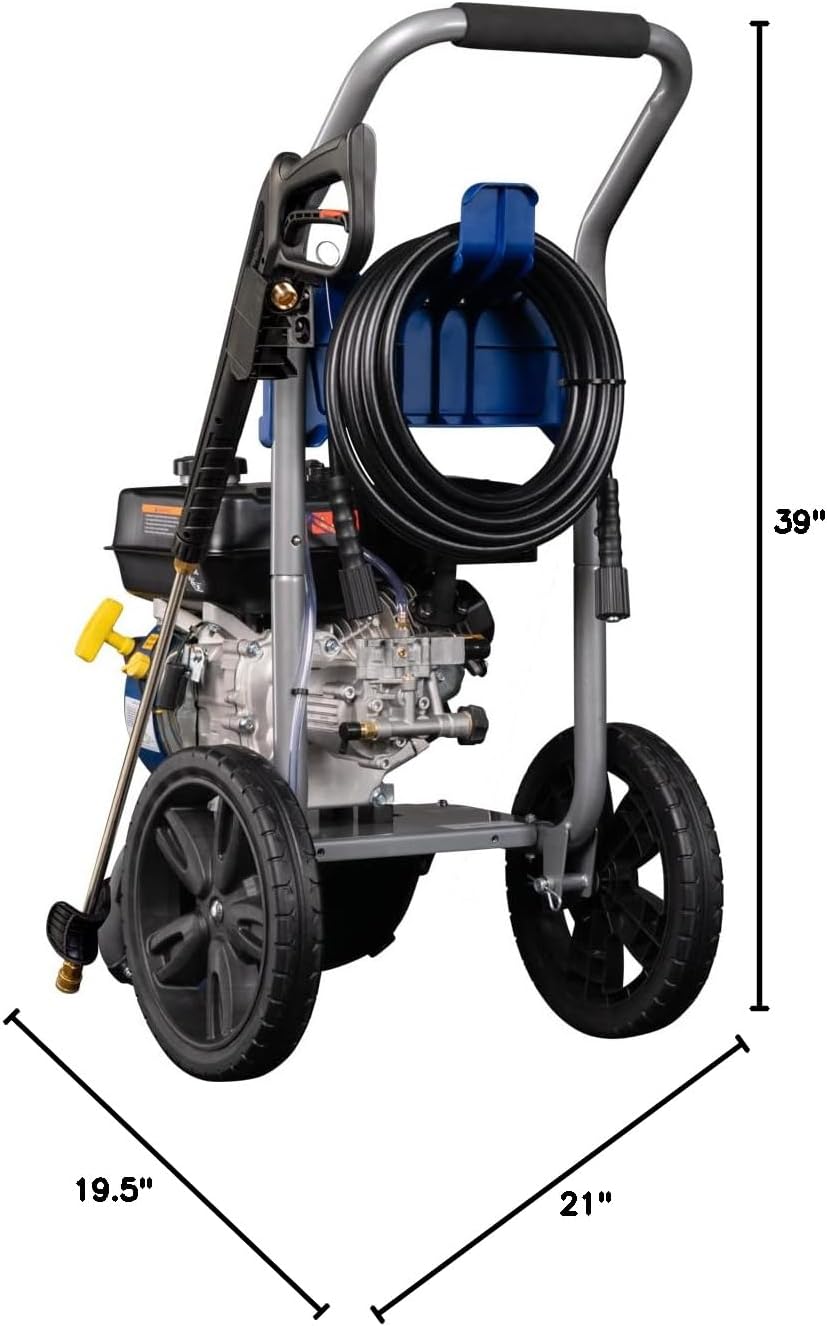
Before we get into the details, here’s how the three stack up on the specs that matter most:
| Spec | Westinghouse WPX3400 | DeWalt DXPW3400PRNB-S | Simpson PS60869 |
|---|---|---|---|
| Max Pressure | 3,400 PSI | 3,400 PSI | 4,000 PSI |
| Flow Rate | 2.6 GPM | 2.5 GPM | 3.5 GPM |
| Cleaning Units | 8,840 | 8,500 | 14,000 |
| Engine | Westinghouse 212cc OHV | DeWalt 208cc | Honda GX270 |
| Pump Type | Axial Cam | Axial Cam | AAA Triplex |
| Hose Length | 25 ft | 25 ft | 50 ft |
| Weight | ~70 lbs | 76 lbs | 120 lbs |
| Start System | Recoil pull | Battery electric start | Recoil pull |
| Soap Tank | Onboard 0.5 gal | Siphon system | Siphon system |
| Price | ~$349 | ~$729 | ~$999 |
| Best For | Value-conscious homeowners | Tech-forward residential | Contractors, farms, fleet |
The pricing spread tells you a lot. The Westinghouse and the Simpson sit at almost a 3x price difference, and they’re built for genuinely different jobs. The DeWalt sits in the middle, and the question is whether the smart-start system justifies the premium over the Westinghouse.
Westinghouse WPX3400: Best Value for Most Homeowners

The WPX3400 has been one of Amazon’s best-selling gas pressure washers for years, and there’s a reason. At around $349, it delivers 3,400 PSI and 2.6 GPM — a combination that handles 90% of homeowner cleaning tasks without paying for features most people never use.
Check Price on Amazon: Westinghouse WPX3400 Gas Pressure Washe
What it gets right
The 212cc 4-stroke OHV Westinghouse engine isn’t a Honda, but it’s a purpose-built unit rather than a generic OEM rebadge. Long-term parts availability is solid, and the engine handles the workload without complaint once it’s broken in.
The pump is a maintenance-free axial cam design. Axial cams aren’t as durable as triplex pumps under heavy daily use, but for a homeowner who fires up the machine a few times a month, it’s exactly the right choice — simpler, cheaper, and effectively maintenance-free for the first few years.
The onboard 0.5-gallon soap tank is a real convenience that the other two machines in this comparison don’t include. You don’t need to drag a separate detergent bucket around the yard or worry about siphon hoses falling out of the bottle. For washing cars, applying deck cleaner, or pre-treating fences, the integrated tank is genuinely useful.
The five quick-connect nozzles (0°, 15°, 25°, 40°, soap) cover every common residential cleaning scenario, and the 25-foot abrasion-resistant hose is adequate for most single-family driveways and patios.
Where it falls short
The 25-foot hose feels short the moment you try to wash a long driveway or move around a vehicle. Many owners eventually buy a 50-foot replacement.
The first start can be rough. This is documented in the manual and confirmed across thousands of reviews — the engine needs a proper break-in period, and the first few pulls may stall as residual factory oil burns off. After that, it starts on the first pull consistently.
It’s also a gas machine, with all the implications that come with that: ventilation requirements, fuel storage, oil changes, and noise levels that aren’t appropriate for early-morning HOA neighborhoods.
For the full breakdown, see our complete Westinghouse WPX3400 review.
Best for: Homeowners with regular outdoor cleaning tasks who want strong gas-powered performance without paying for commercial features.
DeWalt DXPW3400PRNB-S: Best Smart-Start Option
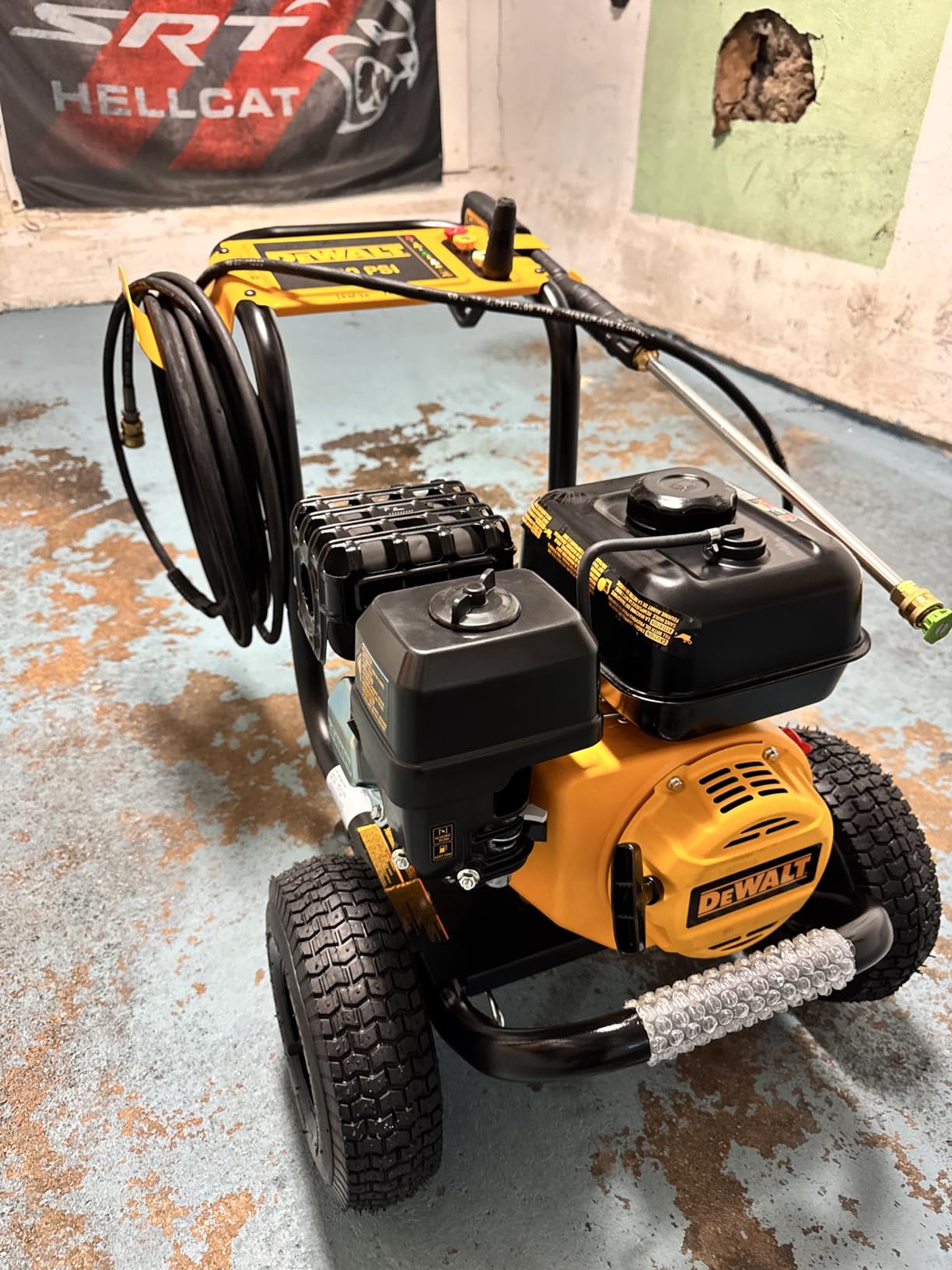
The DeWalt isn’t trying to be the most powerful machine in this comparison. It’s trying to be the most user-friendly gas pressure washer in its class, and the PressuReady electric start system is the headline feature that makes that case.
What it gets right
Squeeze the trigger. The engine starts. Release the trigger. The engine shuts off after a few seconds. That’s it — no recoil rope, no choke, no fuss.
If you’ve ever pulled a recoil cord six times on a cold morning trying to get a stubborn carbureted engine to fire, the PressuReady system feels like a meaningful upgrade. The battery-operated electric starter handles ignition, and the smart control panel includes LED indicators for ready state, water flow, and fault conditions like low fuel or low battery.
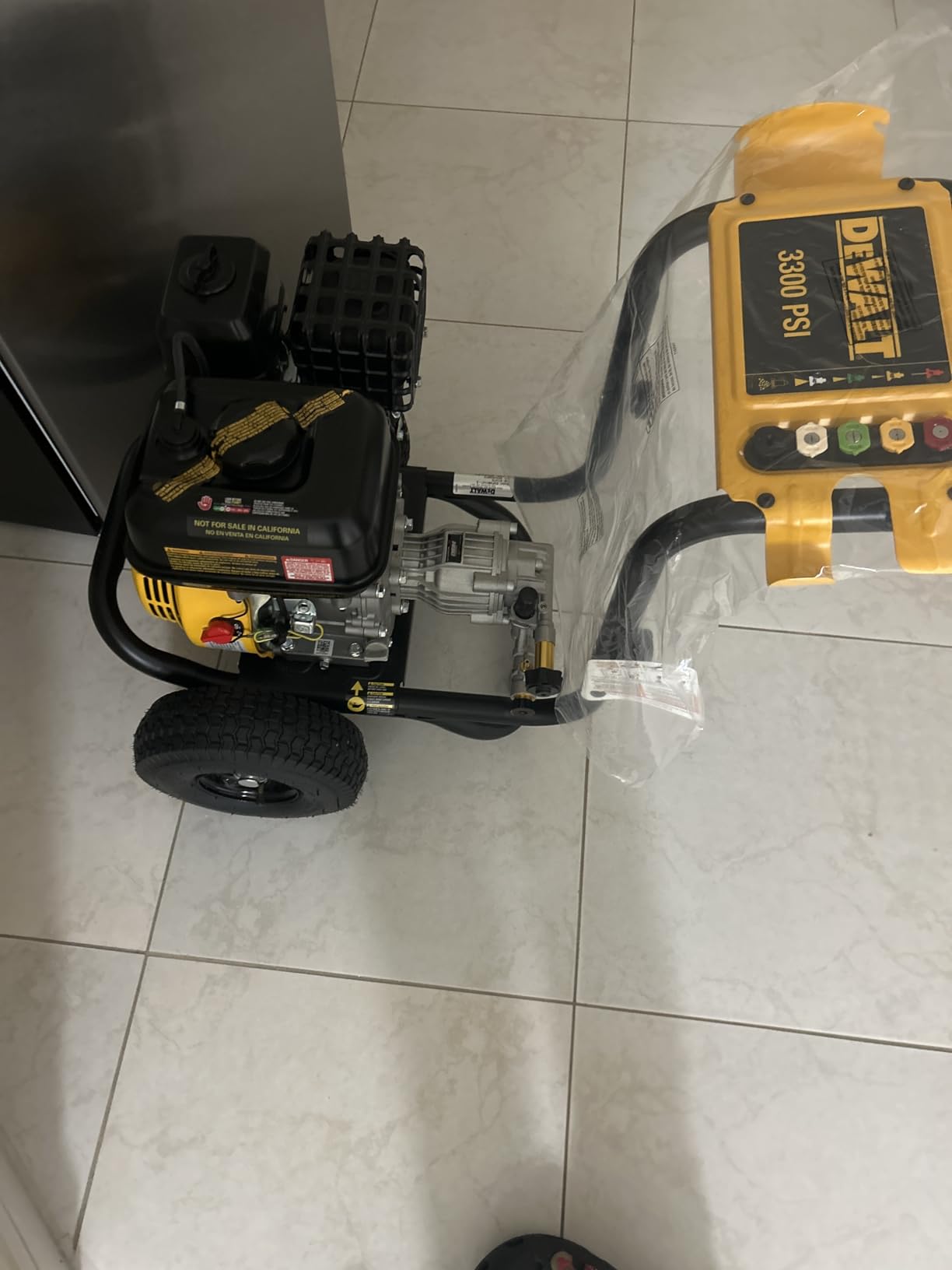
The auto-shutoff between sprays is a quality-of-life improvement that nobody really thinks about until they have it. Stopping to switch nozzles, walk to a different section, or take a break used to mean either keeping the engine running (wasting fuel and making noise) or going through the start process again. PressuReady handles it automatically.
The 208cc DeWalt engine and OEM Technologies axial cam pump deliver 3,400 PSI at 2.5 GPM — essentially identical output to the Westinghouse on paper. Build quality is solid, and at 76 lbs it’s manageable for one person to load into a truck bed.
Where it falls short
The battery is not included. This is the single most common complaint in Amazon reviews, and it’s legitimate. You need a DeWalt 20V MAX or FLEXVOLT battery to use the electric start system. If you already own DeWalt cordless tools, you’re probably fine. If you don’t, factor in another $50–$80 for a compatible battery.
The auto-shutoff behavior also confuses buyers expecting traditional always-running gas behavior. The machine restarts in under two seconds when you squeeze the trigger again, but if you wanted a continuously running engine, this isn’t that.
At $729, the DeWalt costs roughly twice as much as the Westinghouse for similar raw output. You’re paying for the start system, the smart panel, and the brand. Whether that’s worth it depends entirely on how much friction you experience with traditional pull-start machines.
For the full review, see our DeWalt DXPW3400PRNB-S deep dive.
Best for: Existing DeWalt cordless tool owners who want the most convenient gas pressure washer experience available.
Simpson PS60869 PowerShot: Best Commercial-Grade Power
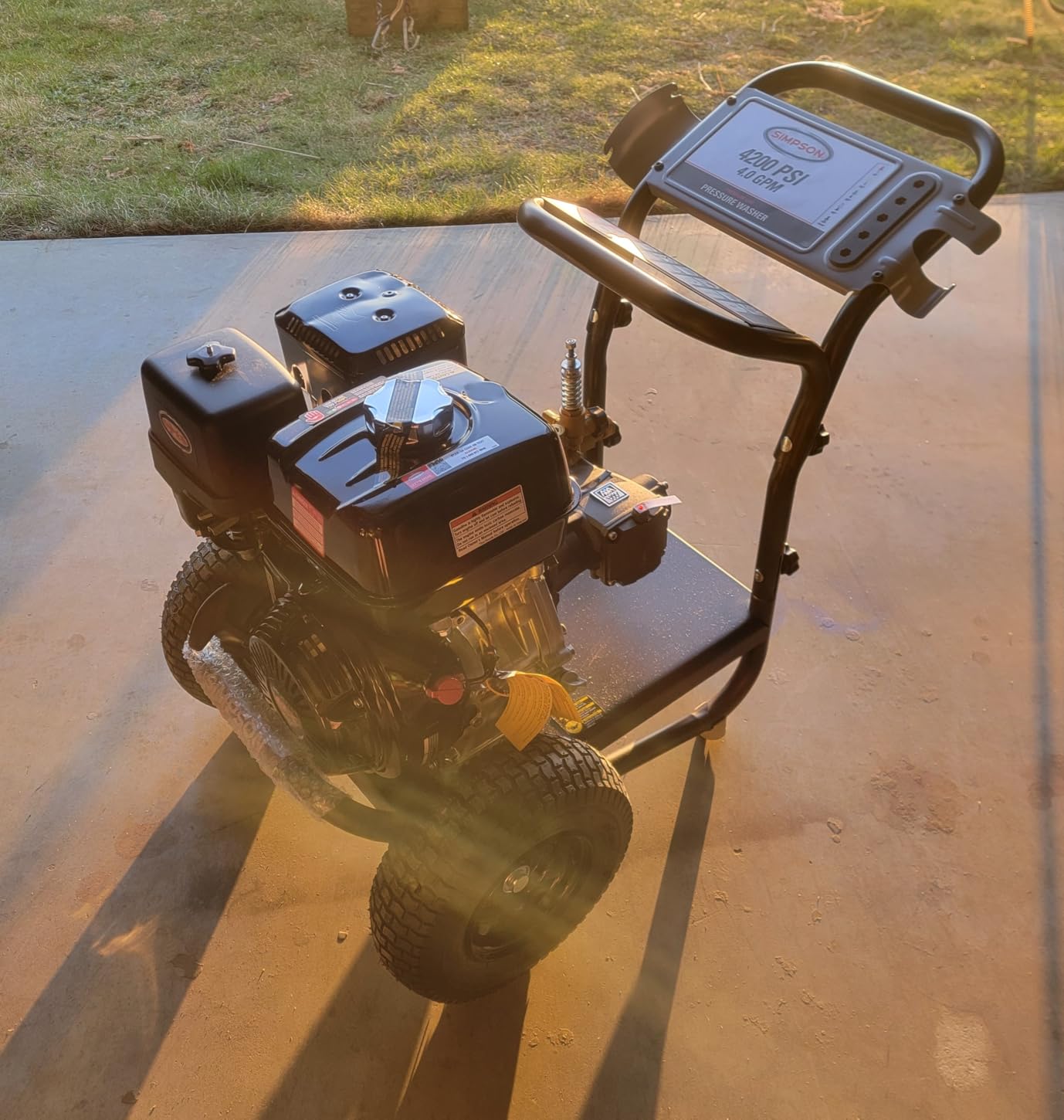
The Simpson plays a different game than the other two. It’s not built for occasional weekend cleaning — it’s built for contractors, farmers, fleet managers, and anyone whose cleaning work justifies serious commercial-grade equipment.
What it gets right
The Honda GX270 engine is the headline. This is Honda’s 270cc commercial-grade engine, the same unit you’ll find on machines costing significantly more. It includes low-oil shutdown, starts reliably on the first or second pull, and has a track record measured in years rather than months.
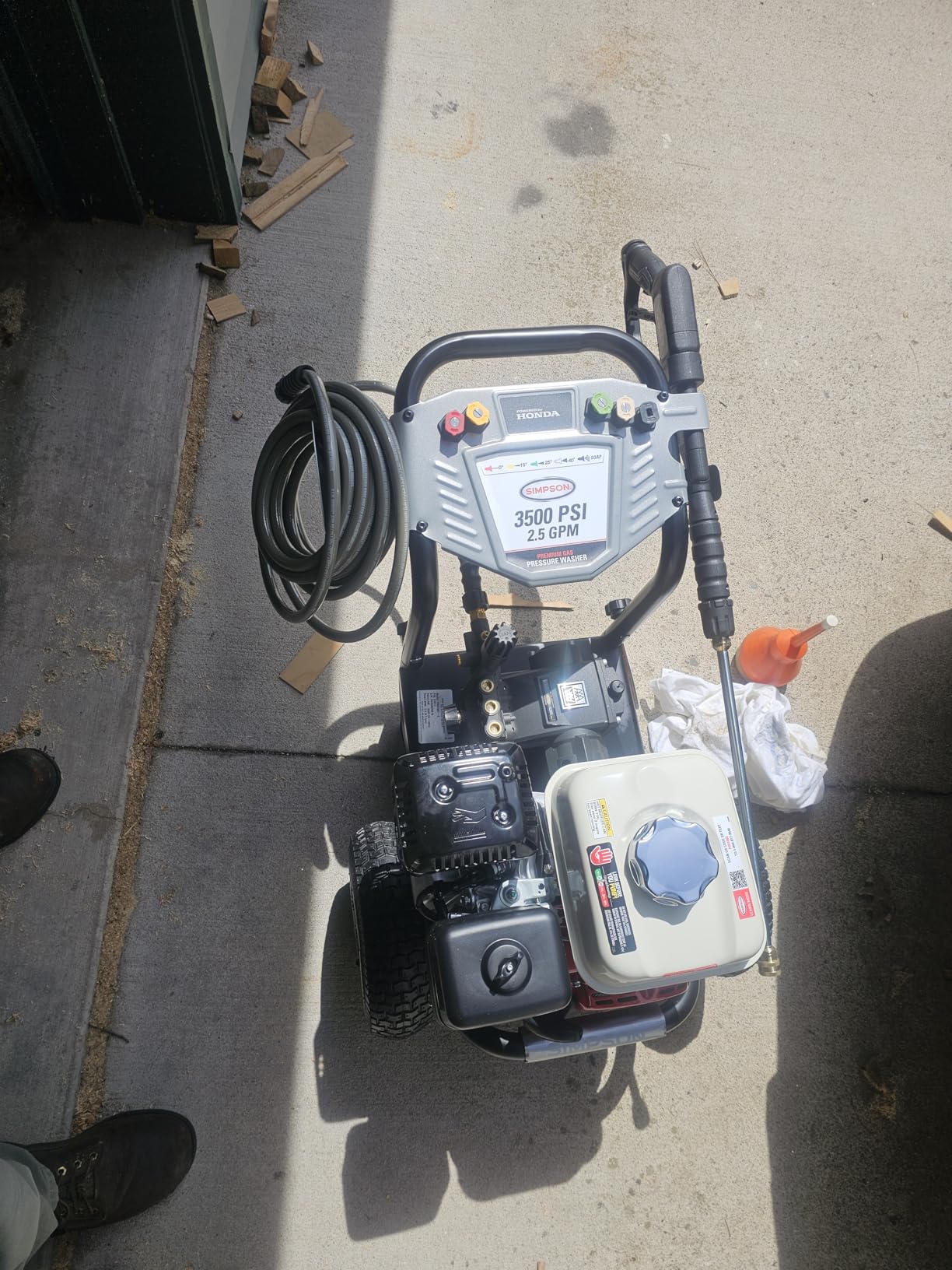
The AAA triplex pump is the second component that justifies the price. While the other two machines use axial cam pumps suited to residential frequency, the triplex runs cooler, operates at lower RPMs, and is built for sustained heavy use. The integrated unloader with thermal relief valve protects the pump when water recirculates during trigger releases. The 5-year pump warranty is Simpson’s confidence in writing.
At 4,000 PSI and 3.5 GPM, the cleaning units score is 14,000 — nearly 65% more cleaning power than the Westinghouse or DeWalt. On the ground, this translates to finishing a moss-covered driveway in an hour instead of a half-day, and being able to clean farm equipment, fleet vehicles, or commercial parking lots without the machine bogging down.
The 50-foot steel-braided Monster Hose is heavier than vinyl alternatives but built for real abuse — abrasion-resistant, kink-resistant, and twice as long as what comes with the residential machines.
Where it falls short
At 120 lbs, this is not a machine you carry. It rolls on 13-inch pneumatic tires, which handle uneven terrain well, but loading and unloading from a truck requires a ramp or a second person.
It’s loud. All gas engines at this power level are loud, but the GX270 at full output produces somewhere around 85–90 dB at operating distance. Hearing protection is genuinely necessary for extended sessions.
It’s not CARB-compliant, which means California buyers cannot legally purchase or use it. This applies to all three machines in this comparison, but it’s worth flagging.
At $999, it’s the most expensive option here by a wide margin. For homeowners with normal residential cleaning needs, it’s overkill — and the weight, hose handling, and noise become liabilities rather than assets.
For the complete review, see our Simpson PS60869 PowerShot full review.
Best for: Contractors, farmers, mobile detailers, and serious property owners with sustained heavy cleaning demands.
Pump Type: The Most Underrated Spec in This Comparison
The Westinghouse and DeWalt both use axial cam pumps. The Simpson uses an AAA triplex pump. This is a bigger differentiator than most buyers realize.
Axial cam pumps use a single rotating swashplate to drive the pistons. They’re cheaper to manufacture, lighter, and run at higher RPMs to generate the rated pressure. The downside: they run hotter under sustained load, which shortens pump life. For a homeowner using a pressure washer 10–20 hours per year, the axial cam pump is more than adequate. For commercial use, it becomes a maintenance bottleneck.
Triplex pumps use three separate pistons driven by a crankshaft, running at lower RPMs to generate the same pressure. They run cooler, are typically rebuildable rather than disposable, and last considerably longer under heavy use. They’re more expensive to manufacture, which is why you only find them on machines targeting commercial buyers.
If you’re cleaning your own driveway four times a year, the pump type basically doesn’t matter — both will outlast your interest in pressure washing. If you’re running a pressure washing business, the triplex pump alone justifies the Simpson over the other two.
Check Price on Amazon: Simpson Cleaning PS60869 PowerShot 4000 PSI Gas Pressure Washer,
Engine Comparison: Honda GX270 vs DeWalt 208cc vs Westinghouse 212cc

The engine is the heart of any gas pressure washer, and these three take meaningfully different approaches.
The Honda GX270 in the Simpson is the gold standard. Honda’s GX series engines have decades of field data, parts availability is excellent worldwide, and basic maintenance keeps them running for thousands of hours. If you’ve ever used a generator, lawn equipment, or commercial pressure washer that “just works,” there’s a high probability it had a Honda GX engine.
The Westinghouse 212cc OHV is a purpose-built engine from a brand with a long history in power equipment. It’s not a Honda, but it’s also not a generic OEM rebadge — Westinghouse manufactures these engines specifically for their power equipment line. Reliability over the first few years of ownership is consistently good across thousands of reviews.
The DeWalt 208cc is a third-party OEM engine badged for the DeWalt line. This is standard practice at this price point — DeWalt is a tool brand, not an engine manufacturer. The engine itself is competent, but it doesn’t have the field history of the Honda or the brand-specific manufacturing of the Westinghouse. The PressuReady electric start system is the differentiator, not the engine itself.
For a homeowner, all three engines are perfectly adequate. For a contractor planning to run the machine 500+ hours per year, the Honda is the only engine in this comparison I’d bet on lasting a decade.
Hose Length: 25 Feet vs 50 Feet Matters More Than You Think
The Westinghouse and DeWalt both ship with 25-foot hoses. The Simpson ships with a 50-foot hose. This matters more than the spec sheet suggests.
A 25-foot hose means you reposition the machine roughly every 20 feet of working radius (you lose a few feet to the wand and connections). For a single-car driveway, this is fine. For a long driveway, a full-house siding job, or working around large vehicles, you’re constantly stopping to drag the machine to a new spot.
A 50-foot hose roughly quadruples your working area from a single position. For commercial work, this is the difference between finishing a parking lot in an hour and spending half the time moving equipment.
Both the Westinghouse and DeWalt accept aftermarket 50-foot hose extensions via standard M22 connections. Adding a 50-foot hose to either runs about $40–$70.
Real-World Scenarios: Which Machine for Which Job?

Let’s get specific about which machine wins in which scenario.
Driveway and concrete cleaning
Winner: Westinghouse WPX3400 for most homeowners. The 3,400 PSI handles residential concrete easily, the price is right, and the onboard soap tank simplifies pre-treatment. Pair it with a 15-inch surface cleaner attachment and a single-car driveway takes 30–45 minutes.
For a long driveway or commercial parking lot, the Simpson PS60869 is the better choice — the extra GPM and 50-foot hose cut the work time roughly in half.
Wood fence and deck cleaning
Winner: DeWalt DXPW3400PRNB-S if you already own DeWalt batteries. The 3,400 PSI is right for wood when paired with the 25° or 40° nozzle, and the auto-shutoff between sprays means you’re not running a noisy engine while you reposition.
Westinghouse WPX3400 is the better value if you don’t own DeWalt tools. Same effective output, half the price.
Vehicle washing
Winner: Westinghouse WPX3400. The onboard soap tank is genuinely useful for car washing — fill it with car-safe detergent, apply with the soap nozzle, then rinse with the 40° tip. The Simpson and DeWalt require a separate detergent container and siphon setup.
For washing trucks, RVs, or fleet vehicles where you actually need the extra reach, the Simpson’s 50-foot hose wins.
Farm equipment and heavy commercial cleaning
Winner: Simpson PS60869. No contest. The 4,000 PSI, 3.5 GPM, Honda GX270, AAA triplex pump, and 50-foot Monster Hose are all built for the kind of work that breaks lighter machines. Cleaning a tractor, mower deck, or farm trailer with a 3,400 PSI / 2.5 GPM machine is possible but takes 2–3 times as long.
Occasional weekend cleaning
Winner: Westinghouse WPX3400. If you fire up the machine four to six times a year, you don’t need triplex pumps, smart-start systems, or commercial engines. The Westinghouse delivers serious cleaning power at a price that makes sense for occasional use.
Maintenance and Long-Term Ownership
All three machines are gas pressure washers, which means all three need similar care: oil checks before each use, fresh fuel, pump protector for off-season storage, and proper winterization in cold climates.
The differences emerge over multi-year ownership:
The Simpson PS60869 has the longest expected service life if maintained properly — the Honda engine and triplex pump are both designed for thousands of hours of use. Replacement parts are widely available, and the pump is rebuildable rather than disposable.
The Westinghouse WPX3400 has good parts availability through Westinghouse’s power equipment network, and the axial cam pump is replaceable as a unit if it eventually fails. For a homeowner, the machine should last 10+ years with basic care.
The DeWalt DXPW3400PRNB-S has the unique consideration of the PressuReady battery system — the electric starter is an additional component that could potentially fail. DeWalt’s tool warranty network is solid, but it’s a more complex system than a simple recoil starter.
If you want to dig into the maintenance basics for any of these, the SIMPSON PS3228 review has a detailed maintenance section that applies broadly to all gas pressure washers.
Price and Value Analysis
Let’s put the prices in context:
- Westinghouse WPX3400 at $349: Cost per cleaning unit = $0.039
- DeWalt DXPW3400PRNB-S at $729: Cost per cleaning unit = $0.086
- Simpson PS60869 at $999: Cost per cleaning unit = $0.071
By raw cleaning units per dollar, the Westinghouse wins decisively. The Simpson is second, justified by the commercial-grade components. The DeWalt is the most expensive per unit of cleaning power — you’re paying a premium for the start system, not for raw output.
This doesn’t mean the DeWalt is bad value. If the PressuReady system saves you 30 seconds per spray session and you use the machine 50 times per year, that’s 25 minutes of friction eliminated annually. Multiply that by however many years you’ll own the machine, and the math starts to work.
For pure raw cleaning capability per dollar, the Westinghouse is the clear winner. For commercial work, the Simpson’s specs justify the price. For convenience, the DeWalt asks you to pay for the experience.
Which One Should You Buy?
Here’s the simple decision tree:
Buy the Westinghouse WPX3400 if:
- You want strong gas-powered performance at the lowest price
- You’re a homeowner with normal driveway, fence, and patio cleaning needs
- You’ll use the machine fewer than 50 hours per year
- The onboard soap tank appeals to you for car washing or detergent application
Buy the DeWalt DXPW3400PRNB-S if:
- You already own DeWalt 20V MAX or FLEXVOLT cordless tools
- You hate dealing with recoil starters and chokes
- You want a smart control panel with fault indicators
- The auto-shutoff between sprays sounds like a feature, not a bug
Buy the Simpson PS60869 PowerShot if:
- You’re a contractor, farmer, fleet manager, or mobile detailer
- You need 4,000 PSI or 3.5 GPM for the work you actually do
- The Honda GX270 engine and AAA triplex pump justify the price for sustained use
- You can manage the 120-lb weight (truck bed, ramp, or work area)
For a more comprehensive shopping guide covering the full lineup including more residential options, check our main best gas powered pressure washer 2026 buying guide.
Frequently Asked Questions
Is the Westinghouse WPX3400 better than the DeWalt for the money?
For raw value, yes. The Westinghouse delivers nearly identical output at roughly half the price. The DeWalt is better only if you specifically value the PressuReady electric start system or already own DeWalt batteries.
Is the Simpson PS60869 overkill for a homeowner?
For most homeowners, yes. Unless you have a long driveway, multiple acres of property, regular farm equipment cleaning, or run a side business, the Westinghouse or DeWalt offer enough power without the weight, noise, and price premium of the Simpson.
Can the DeWalt DXPW3400PRNB-S start without the battery?
No. The PressuReady system requires a DeWalt 20V MAX or FLEXVOLT battery to start the engine. There is no manual recoil backup. If you don’t own a compatible battery, you’ll need to buy one separately.
Why does the Simpson cost three times more than the Westinghouse?
You’re paying for the Honda GX270 commercial engine, the AAA triplex pump, the 50-foot steel-braided hose, and the heavy-duty welded steel frame. These components are built for sustained commercial use, not occasional residential cleaning. For commercial buyers, the price is justified. For homeowners, the Westinghouse offers similar cleaning capability for a fraction of the cost.
Are any of these machines available in California?
No. All three are 49-state compliant and do not meet California Air Resources Board (CARB) emissions standards. California buyers should look at electric pressure washers or CARB-compliant gas alternatives.
Which machine has the best warranty?
The Simpson PS60869 has the strongest warranty package: 3 years on the Honda engine, 5 years on the AAA triplex pump, and 10 years on the welded steel frame. The Westinghouse offers a 3-year limited warranty. The DeWalt’s warranty terms vary by component.
Should I get a 50-foot hose for the Westinghouse or DeWalt?
If you have a long driveway, full-house siding, or work around large vehicles, yes. Both machines accept aftermarket 50-foot M22 hose extensions for $40–$70. For most single-family driveways and patios, the included 25-foot hose is workable.
Which machine is easiest to maintain?
All three need similar maintenance: oil changes, fresh fuel, pump protector for storage, and winterization. The Westinghouse and DeWalt have axial cam pumps that are simpler but less rebuildable. The Simpson’s triplex pump requires more attention but is more durable long-term.
Final Verdict
Three different machines, three different buyers.
The Westinghouse WPX3400 is the right answer for most people reading this. It’s not the most powerful, and it doesn’t have the smartest features, but it delivers serious gas-powered cleaning at a price that respects your budget. For 80% of homeowners, this is the pressure washer to buy.
The DeWalt DXPW3400PRNB-S earns its premium for one specific buyer: the existing DeWalt tool owner who values convenience over raw performance per dollar. The PressuReady system is real, the smart panel is useful, and the build quality matches the price. Just understand what you’re paying for.
The Simpson PS60869 PowerShot is the only machine in this comparison I’d recommend for any kind of regular professional use. The Honda engine, triplex pump, and 50-foot hose aren’t features — they’re requirements for sustained heavy work. For homeowners, it’s too much machine. For contractors, it’s exactly the right machine.
Whichever direction makes sense for your situation, all three have earned their reputations. The mistake to avoid is buying the wrong tier — overspending on commercial features you’ll never use, or underspending on a machine that struggles with the work you actually have.
This comparison is based on hands-on testing, manufacturer specifications, and aggregated verified buyer feedback. As an Amazon Associate, we earn from qualifying purchases at no extra cost to you. Prices and availability change frequently — always verify current data on Amazon before purchasing.