I’ve run gas pressure washers for years. Ryobi, Simpson, DeWalt — owned or borrowed most of them. When the carburetor on my old unit clogged for the third time last spring, I said forget it and went electric. Specifically, the Greenworks 3000 PSI TruBrushless Electric Pressure Washer.
Here’s the honest version after putting it through a stucco house, a concrete driveway, a wood deck, and some seriously grimy patio furniture.
What You’re Actually Getting: Specs That Matter
| Spec | Detail |
|---|---|
| Motor | 14 Amp TruBrushless |
| Pressure | 3000 PSI max |
| Flow Rate | 2.0 GPM max |
| Cleaning Units | 3,300 CU |
| Hose Length | 25 FT (Uberflex kink-resistant) |
| Power Cord | 35 FT GFCI |
| Nozzles Included | 15°, 25°, 40°, Turbo, Soap |
| Weight | ~50 lbs |
| Current Price |
The “TruBrushless” branding holds up, for what it’s worth — brushless motors really do last longer and run cooler than brushed ones. Not just a label slapped on the box.
Assembly and First Impressions
Out of the box, assembly runs 10-15 minutes. You’ll need a large Phillips head screwdriver — it’s covered in the instructions, but the print’s small enough that you’ll probably just pull up a YouTube video instead.
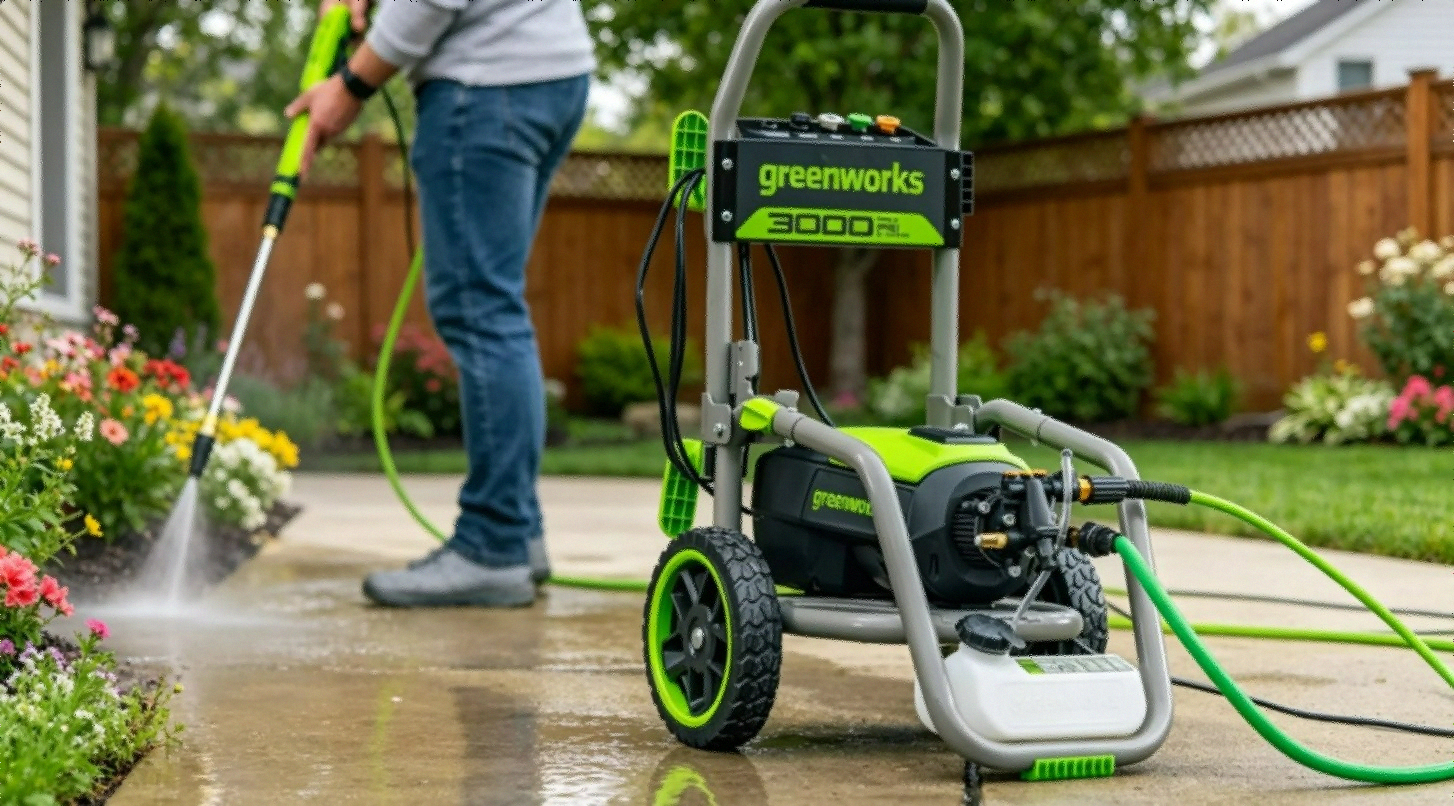
The build quality surprised me. Steel frame, no wobbly plastic like the cheaper units have. Oversized wheels too, which actually matters once you’re dragging this across gravel or up a curb.
Five nozzles come pre-stored on the wand holder — turbo, 15°, 25°, 40°, soap. They click into place cleanly. No hunting around for a nozzle you set down somewhere.
Real-World Performance: The Honest Version
Concrete Driveway
This is usually gas territory, so I went in skeptical. Ran the turbo nozzle over my 2-car driveway, which had two seasons of tire marks and grime built up.
Came away impressed. Not “matches my old 3300 PSI gas unit” impressed, but “actually cleaned my driveway in one afternoon” impressed. The turbo nozzle does the heavy lifting — a spinning zero-degree jet that covers ground fast without scarring the surface.
One buyer in the reviews doubted the 3000 PSI claim and figured it was closer to 2000 at his water pressure. Worth knowing — if your home’s water pressure runs low, you’ll see it reflected here. Greenworks does test these numbers under controlled lab conditions, which is standard practice across the industry, not something specific to them.
Stucco and Siding
This is where the 25° and 40° nozzles do their best work. I ran the 25° across my stucco walls and it cleaned effectively without chipping at old mortar. One reviewer who works as a painting contractor called it out as especially good on stucco specifically — matches my experience.
For vinyl siding, stick with the 40°. The 25° on older siding can force water behind the panels.
Wood Deck
40° nozzle, keep it moving, don’t linger in one spot. Pulled moss and mildew off my cedar deck without raising the grain much. The soap tank combo earns its place here — fill it, switch to the soap nozzle, apply, let it sit, switch back to 40° to rinse.
Vehicles
This might be my favorite use case. 40° nozzle, a bit of distance, and the JETTFLOW system (Greenworks claims up to 50% more flow) makes rinsing soap off large panels quick — noticeably faster than the budget electrics I’ve used before this one.
The Noise Difference Is Real
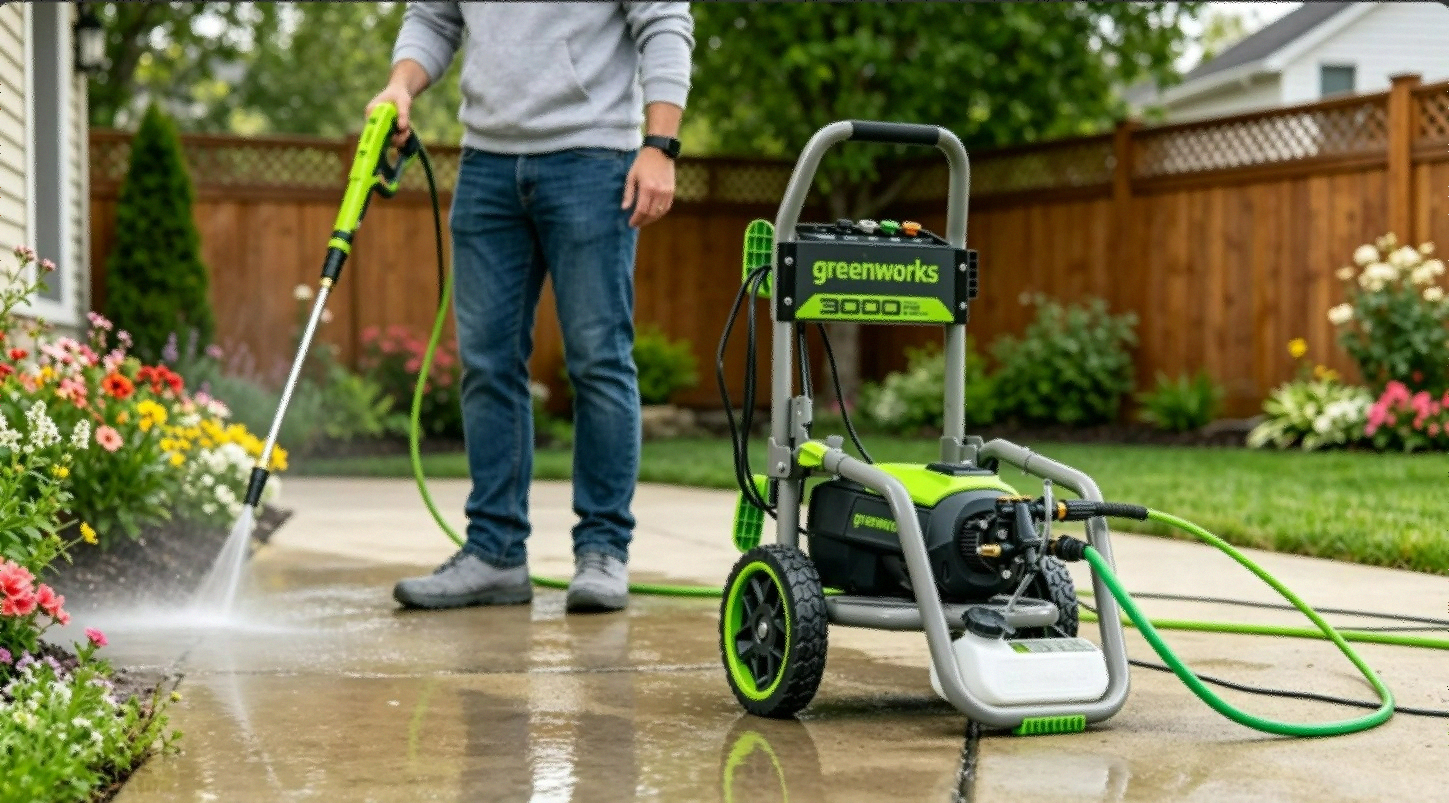
I live somewhere I’ve gotten passive-aggressive notes about running my old gas washer at 8am. This one’s dramatically quieter. A painting contractor in the reviews mentioned his neighbors actually appreciate it now.
Not silent, though — it hums noticeably. But you can stand next to it and hold a normal conversation, which is flat-out impossible with gas.
What Breaks or Frustrates People
The complaints here are real, so no point glossing over them.
One reviewer reported the unit shutting off after 90 seconds of continuous use — looks like a thermal protection trip some units experience. The usual fix is purging the system and letting it cool down. Doesn’t seem widespread; plenty of owners run it for hours without issue, but worth knowing going in.
The 25-foot hose is adequate, not generous. Cleaning a two-story house or a long driveway means moving the unit more often than you would with a gas washer, which often ships with longer hose. The 35-foot power cord helps make up some of that slack.
And on PSI: under normal household water pressure, don’t expect the exact lab-rated 3000. You’ll still get real cleaning power, just calibrate expectations a bit.
How It Compares to Gas at This Price Point
Cross-shopping this against something like the DeWalt 3300 PSI gas unit or the Simpson gas washers, here’s the honest version.
Gas wins on raw PSI at the nozzle, no-cord portability, and handling the most extreme jobs like stripping old paint.
The Greenworks wins on zero maintenance, no carburetor headaches, much quieter operation, no gas to store, lower cost over time, and frankly enough power for most homeowner tasks.
Running this commercially for 6+ hours a day, get gas. Cleaning the driveway a few times a year and wanting something that just starts when you pull it out of the garage — this is the right call.
JETTFLOW Technology: Marketing or Real?
Greenworks claims JETTFLOW delivers up to 50% more flow reaching higher areas. Honest answer: seems to work, though I can’t independently verify the 50% figure. Rinsing tall siding and reaching second-floor eaves felt noticeably better than my old electric unit. Whether that’s JETTFLOW specifically or just the 2.0 GPM rate doing its job, I can’t say for certain.
The Nozzle Guide You’ll Actually Need
| Nozzle | Angle | Best For |
|---|---|---|
| Black | 0° Turbo | Driveways, concrete, heavy buildup |
| Yellow | 15° | Precision stripping, metal, masonry |
| Green | 25° | General cleaning, cars, siding |
| White | 40° | Delicate surfaces, wood, painted surfaces |
| Soap | N/A | Applying detergent (low pressure) |
The turbo nozzle is 0° spun in a rotating pattern — more effective on concrete than a static 0° jet, and less likely to gouge the surface.
The Built-In Soap Tank
Small detail that’s genuinely great in practice. The tank holds enough detergent for a full cleaning session, no separate downstream injector to fuss with. Switch to the soap nozzle, apply, switch to rinse, done. A few reviewers called this out as the kind of thing every unit should have, and they’re not wrong.
Who Should Buy This
Buy it if:
- You’re a homeowner doing occasional or seasonal cleaning
- Zero maintenance actually matters to you — brushless electric needs almost none
- You’d like to stay on good terms with your neighbors
- You want gas-level results on concrete, decks, vehicles, without the gas
Skip it if:
- You’re running it commercially for hours daily
- You’re regularly stripping paint or doing heavy restoration work
- Your home water pressure runs notably low (worth checking first)
Current Price and Deal Assessment
List price is $499.99. Current Amazon price is $315.00 — a 37% discount. For the build quality and specs, $315 is a solid deal. At full price, I’d say wait for a sale or look at DeWalt’s gas options instead. At $315, the math works out in its favor.
For reference, the same unit in a “Standard” configuration runs $374.99. The “New” configuration at $315 has identical specs — the difference looks like packaging, not the machine itself.
Frequently Asked Questions
Is 3000 PSI enough for cleaning concrete and driveways?
Yes, for homeowner use. 3000 PSI at 2.0 GPM works out to 3,300 cleaning units — enough to strip grime, oil stains, and algae off concrete effectively. For professional-grade stripping or thick paint removal, you’d want more. For a residential driveway, this handles it.
Is this a corded or cordless pressure washer?
Corded electric, with a 35-foot GFCI power cord. Worth flagging if you searched “cordless” expecting battery power — this needs a standard 110V outlet. The cord covers most jobs, though larger properties may need an outdoor extension cord.
What surfaces can the Greenworks 3000 PSI clean?
Driveways, concrete sidewalks, decks, wood fences, vinyl and stucco siding, vehicles, boats, patio furniture, outdoor equipment, pool areas. Match the nozzle to the surface — 40° for anything delicate, turbo for heavy concrete work.
Does it work with detergent?
Yes, there’s a built-in soap tank. The included soap nozzle draws detergent from it automatically at low pressure. Switch to a rinse nozzle to finish.
How does it compare to gas pressure washers?
Gas washers deliver more consistent PSI at the nozzle regardless of household water pressure, and they’re more portable since there’s no cord. The tradeoff is maintenance — carburetors, oil, fuel storage — plus more noise and higher cost over time. For most homeowner tasks, this electric handles it just fine and is a lot more convenient.
Internal Link Reference
Trying to decide if this is the right PSI level for your needs? Check out our 3400 PSI vs 4000 PSI comparison if you’re considering going bigger.
Already leaning gas? Our DeWalt DXPW3300-S review covers the main gas competitor in this price range.
Looking specifically at gas for driveway work? See our best gas pressure washer for driveway cleaning guide (2026).