Walk into any pressure washer aisle, and the first thing you’ll see is a row of big numbers: 2000, 2500, 3000, 3400, 4000 PSI. Bigger numbers cost more money. Salespeople tell you bigger is better. The internet tells you bigger is better.
The internet is wrong. PSI is one of the most misunderstood specs in the entire pressure washer market, and buying the wrong PSI level either wastes your money or damages your stuff — sometimes both.
This guide settles the question: 3,400 PSI versus 4,000 PSI, which one do you actually need? I’ll cover what PSI really measures, why GPM matters more than most buyers realize, what each PSI tier handles in the real world, and which specific scenarios justify stepping up from residential to commercial-grade machines.
As an Amazon Associate, we earn from qualifying purchases at no extra cost to you.
What PSI Actually Measures (And What It Doesn’t)

PSI stands for pounds per square inch. It’s a measure of pressure — specifically, the force the water exerts on the surface you’re spraying. A 3,400 PSI machine generates 3,400 pounds of force per square inch at the nozzle tip under ideal conditions.
Two things buyers consistently get wrong about PSI:
First, the rated PSI is a maximum, not a constant. The actual pressure reaching your target surface depends on the nozzle angle, the distance from the surface, the hose length, and even how cold your water supply is. A 4,000 PSI machine sprayed through a 40° fan nozzle from three feet away delivers far less pressure per square inch than a 3,400 PSI machine sprayed through a 0° jet from six inches away.
Second, PSI alone doesn’t determine cleaning capability. Two pressure washers with the same PSI can perform completely differently if their flow rates differ. This is where most buyers get tripped up — they pick the highest PSI number on the shelf without realizing they’ve bought a machine that’s slower than a lower-rated unit.
The single number that actually predicts cleaning performance is Cleaning Units (CU), calculated as PSI × GPM. A 3,400 PSI machine at 2.6 GPM has 8,840 cleaning units. A 4,000 PSI machine at 3.5 GPM has 14,000 cleaning units. The 4,000 PSI machine isn’t 18% more powerful — it’s 58% more powerful, because it moves substantially more water at the higher pressure.
Keep this number in mind. We’ll come back to it.
Why GPM Matters as Much as PSI
PSI is the force. GPM (gallons per minute) is the volume of water doing the work.
Think of it this way: PSI is how hard the water hits. GPM is how much water hits. You need both to clean effectively.
A high-PSI, low-GPM machine concentrates force on a small area but lacks the water volume to flush debris away. You blast a stain, you see it loosen, but you can’t carry it off the surface — so you spend twice as long going over the same spot.
A low-PSI, high-GPM machine pushes plenty of water but doesn’t have the cutting force to break embedded grime loose. You move water across the surface effectively, but you’re not actually getting anything off it.
The right balance for most residential cleaning is roughly 2.5 GPM at 3,200–3,400 PSI. For commercial work, you want 3.0–3.5 GPM at 3,800–4,200 PSI. Going higher in either direction doesn’t add proportional cleaning power for typical surfaces — it just adds weight, fuel consumption, and surface damage risk.
Here’s how the three most popular gas pressure washers in this comparison actually stack up:
| Machine | PSI | GPM | Cleaning Units |
|---|---|---|---|
| Westinghouse WPX3400 | 3,400 | 2.6 | 8,840 |
| DeWalt DXPW3400PRNB-S | 3,400 | 2.5 | 8,500 |
| Simpson PS60869 PowerShot | 4,000 | 3.5 | 14,000 |
Notice the Westinghouse and DeWalt are nearly identical in cleaning capability despite the same PSI rating — the GPM difference is small. The Simpson, however, isn’t just 18% more powerful by PSI — it’s 65% more powerful by total cleaning units, because the GPM jump is what does the heavy lifting.
What 3,400 PSI Actually Cleans Well
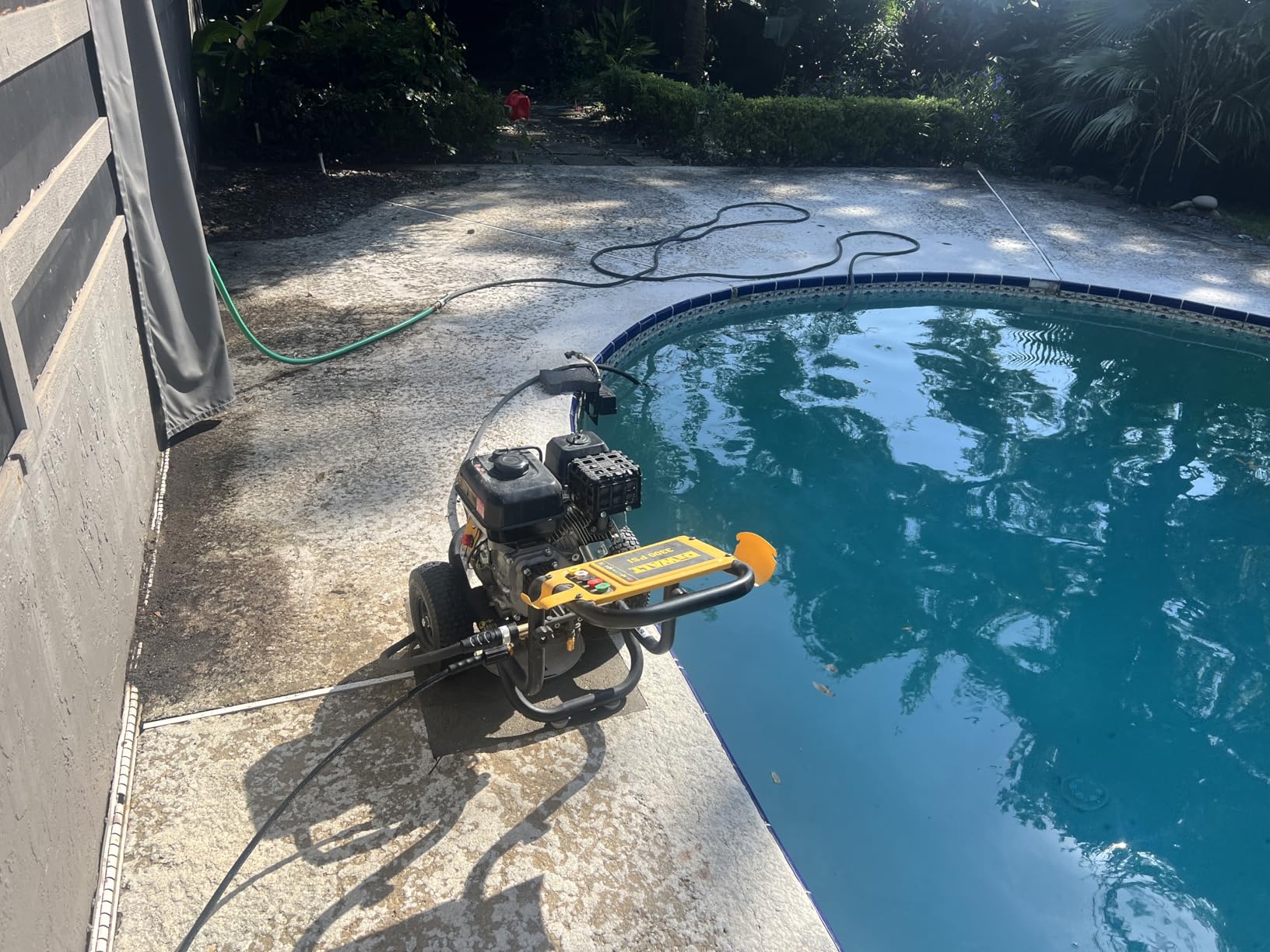
3,400 PSI sits in the sweet spot for residential cleaning. It’s powerful enough to handle every surface most homeowners will ever clean, but not so powerful that it damages delicate materials when used carelessly.
Driveways and concrete
Concrete driveways with normal residential staining — oil drips, mildew, embedded dirt, mossy patches near edges — clean up well at 3,400 PSI with a 25° nozzle. Stubborn spots may need the 15° nozzle and closer working distance, but the surface comes clean without multiple passes. Pair the machine with a 15-inch surface cleaner attachment and a single-car driveway is a 30–45 minute job.
Wood fencing and decking
Wood is the surface where 3,400 PSI starts requiring care. Use the 25° or 40° nozzle, maintain at least 12 inches of distance, and move with the grain. The pressure is high enough to strip paint and lift fibers if you get too close, so technique matters more than power. Done correctly, 3,400 PSI cleans years of mildew and gray weathering off cedar fencing in a single pass.
House siding
Vinyl siding cleans well with the 40° nozzle from 18+ inches away. The wide fan and reduced point pressure prevent water intrusion into seams while still removing organic growth and dirt. Aluminum and fiber cement siding handle 3,400 PSI similarly — the trick is keeping the spray angle perpendicular to the wall, not aimed up under the laps.
Vehicles
This is where 3,400 PSI is technically more pressure than vehicles need, but it works fine with the right nozzle and distance. The 40° nozzle from 24+ inches away rinses cars, trucks, and RVs without paint damage. Get any closer with any narrower nozzle and you risk peeling decals, lifting paint chips, or forcing water into electrical components.
Outdoor furniture, garage floors, walkways
All of these are well within 3,400 PSI’s comfort zone. A 25° nozzle handles concrete walkways, the 40° nozzle works for plastic outdoor furniture, and the 15° nozzle clears garage floors with motor oil staining.
For homeowners with a driveway, fence, deck, vehicles, and a typical residential lot, 3,400 PSI is exactly the right amount of pressure. Going higher doesn’t clean these surfaces faster — it just adds risk and weight.
What 4,000 PSI Actually Cleans Well

4,000 PSI moves the conversation from “homeowner cleaning my own stuff” to “professional or heavy-duty work that breaks lighter machines.” The extra pressure isn’t about doing the same residential jobs faster — it’s about handling work that 3,400 PSI machines genuinely struggle with.
Heavy commercial concrete
Parking lots with years of tire residue, oil spills, gum, and embedded grime. Loading docks. Industrial floors. Sidewalks in commercial districts. These surfaces have deeper, more layered contamination than residential concrete, and the extra GPM at 4,000 PSI is what cuts through it efficiently.
Farm equipment
Tractors, mower decks, manure spreaders, and any equipment exposed to dirt, mud, and biological material. A homeowner with a riding mower can clean it adequately with a 3,400 PSI machine. A farmer cleaning tractors weekly needs the volume and force a 4,000 PSI machine delivers — otherwise, every cleaning job takes 2–3 times longer.
Fleet vehicles
Commercial trucks, semi-trailers, work vans that accumulate road grime, brake dust, and salt residue. The 50-foot hose typical on 4,000 PSI machines isn’t optional for fleet work — it’s necessary to clean a tractor-trailer without repositioning the machine three times.
Wood restoration and paint prep
Stripping old paint, removing failed stain, and preparing decks for refinishing all benefit from the higher GPM. The 25° nozzle at 4,000 PSI / 3.5 GPM cuts through layered material faster than the same nozzle at 3,400 PSI, and the extra water volume flushes loosened material away cleanly.
Graffiti removal and masonry cleaning
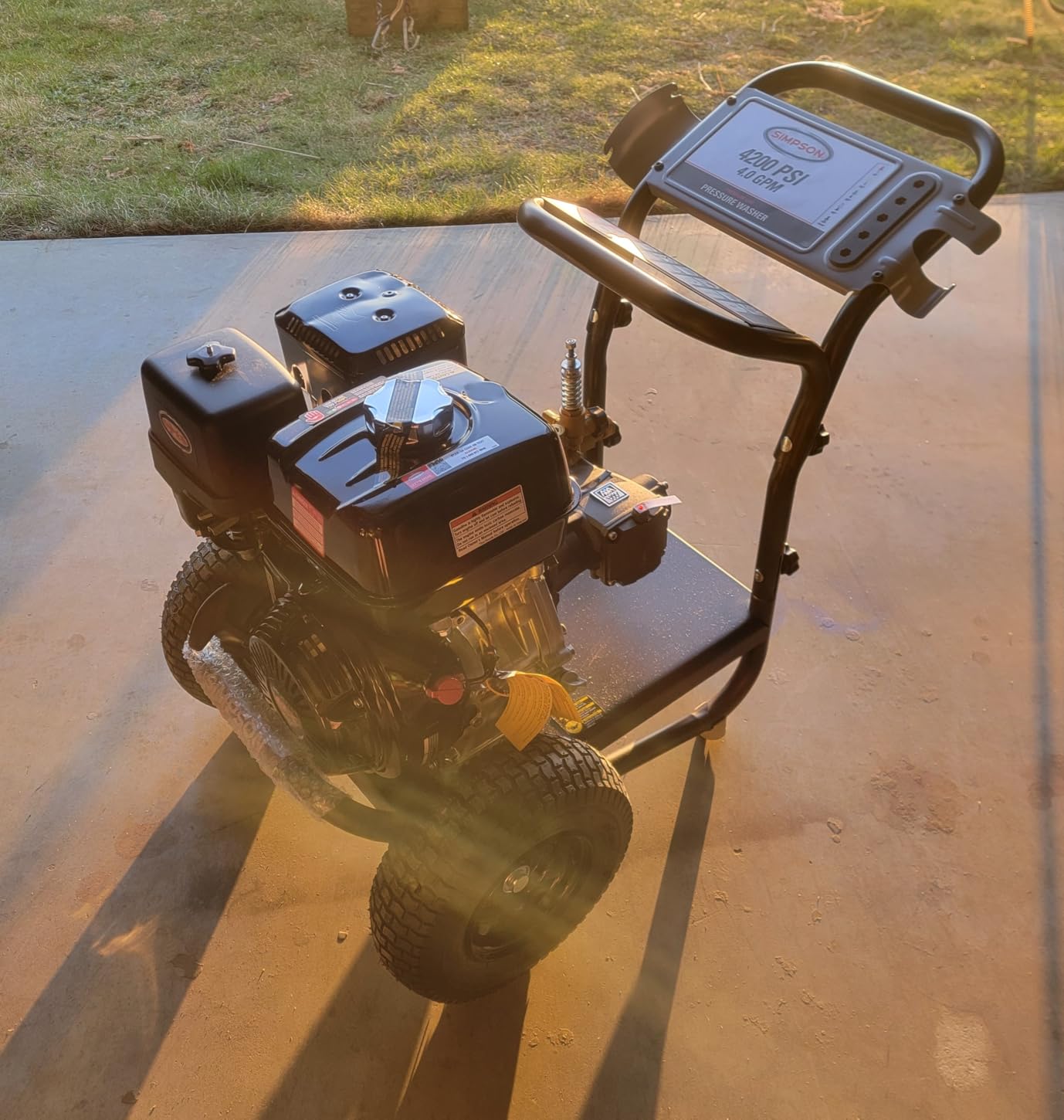
Brick, stone, and masonry surfaces with embedded contamination respond better to higher GPM. The water volume penetrates pores and irregular surfaces more effectively than a high-PSI, low-GPM machine could. For graffiti removal specifically, the combination of pressure and chemical strippers is what works — 4,000 PSI provides the force needed when the chemicals alone aren’t enough.
Heavy equipment cleaning
Construction equipment, demolition gear, anything caked in dried concrete, asphalt, or industrial residue. These applications eat 3,400 PSI machines for breakfast — the pumps overheat, the engines bog down, and cleaning sessions that should take an hour stretch into half a day.
For these scenarios, 4,000 PSI isn’t overkill — it’s the minimum. The contractor running a 3,400 PSI machine for commercial cleaning is doing the same job 60–70% slower than they should be.
When 4,000 PSI Becomes Overkill (Or Dangerous)
Higher PSI isn’t free, and it isn’t always better. There are real downsides to running more pressure than you need.
Surface damage risk
4,000 PSI will strip paint from wood at distances where 3,400 PSI is safe. It will gouge soft cedar with a misplaced 15° nozzle. It will force water under vinyl siding seams that a 40° fan would have left alone. It will lift roofing granules, etch concrete, and turn a careless 0° tip into a tool that can break skin.
Every additional PSI is additional risk. For surfaces that don’t need that pressure, you’re paying with damage potential, not just dollars.
Weight and portability
The 3,400 PSI Westinghouse weighs around 70 lbs. The 4,000 PSI Simpson weighs 120 lbs. That’s 50 extra pounds you have to roll, lift into a truck bed, and store somewhere. For occasional use, the weight penalty is significant. For commercial use where the machine stays on a trailer or in a dedicated truck, weight is less of an issue.
Fuel consumption
Bigger pumps need bigger engines, and bigger engines burn more fuel. A 270cc Honda commercial engine consumes meaningfully more gas per hour than a 208cc residential engine. For a homeowner running the machine four hours a year, fuel cost is irrelevant. For a contractor running it twenty hours a week, it adds up.
Noise
Higher-output engines are louder. The Simpson PS60869 at full output produces around 85–90 dB at operating distance — well into “hearing protection required” territory. The 3,400 PSI machines run quieter, which matters for HOA neighborhoods, residential noise ordinances, and your own ears over a multi-hour cleaning session.
Price
The price gap between 3,400 PSI and 4,000 PSI machines is roughly $350 to $1,000 — close to a 3x markup. For commercial buyers, the price is justified by the work the machine handles. For homeowners, it’s $650 spent on capability you’ll rarely use.
The PSI Ranges by Category
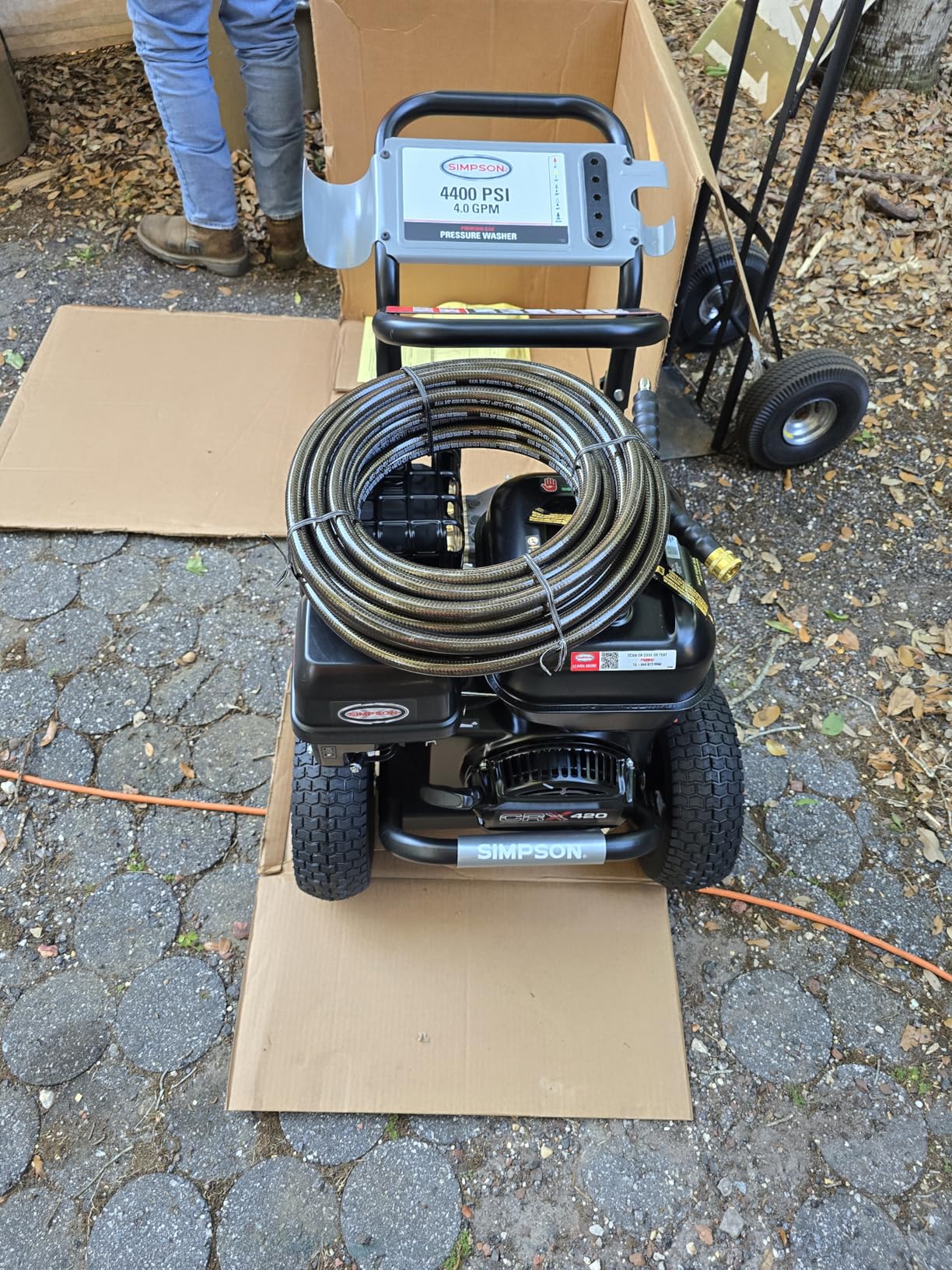
To make this concrete, here’s how the PSI ranges break down across typical pressure washer categories:
Light-duty (1,500–2,000 PSI)
Electric pressure washers, mostly. Good for cars, outdoor furniture, small patios, and bicycles. Inadequate for serious driveway cleaning, paint stripping, or anything embedded into concrete. If your cleaning is genuinely light, this is enough — and it’s quieter, lighter, and cheaper to run.
Medium-duty (2,000–3,000 PSI)
The crossover zone between consumer electric and entry-level gas. Handles light driveway cleaning, vehicle washing, and residential patios. Struggles with embedded staining, mossy concrete, and large flat surfaces where GPM matters.
Heavy-duty residential (3,000–3,400 PSI)
This is where the Westinghouse WPX3400 and DeWalt DXPW3400PRNB-S sit. The right tier for homeowners with regular outdoor cleaning needs — driveways, fences, decks, siding, vehicles. Most homeowners reading this guide should be shopping in this range.
Light commercial (3,400–3,800 PSI)
The SIMPSON PS3228 at 3,300 PSI sits at the upper end of the heavy residential / lower end of the light commercial range. Suited to property managers, light contractor work, and homeowners with very large properties or unusually heavy cleaning demands.
Commercial (3,800–4,500 PSI)
The Simpson PS60869 PowerShot at 4,000 PSI is in this range. Built for contractors, farmers, fleet managers, and serious property owners. Overkill for typical residential use, exactly right for sustained commercial work.
Industrial (4,500+ PSI)
Specialized equipment for surface prep, paint removal, hot-water units, and heavy industrial cleaning. Not relevant to most buyers reading this comparison.
For most readers, the realistic decision is between heavy-duty residential (3,400 PSI) and commercial (4,000 PSI). That’s the question this guide is built around, and the rest of the analysis follows.
Real-World Decision Scenarios
Let me walk through specific buyer profiles and what each one should do.
”I’m a homeowner with a single-car driveway, a deck, and a small fence.”
Buy 3,400 PSI. Anything more is wasted on this scope of work. The Westinghouse WPX3400 at $349 handles all of this and leaves money in your pocket.
”I have a 200-foot driveway, multiple acres of property, and a barn full of equipment.”
You’re in the gray zone. A 3,400 PSI machine works but takes longer. A 4,000 PSI machine works faster but costs more and weighs more. If the equipment cleaning is regular (weekly or more), step up to the Simpson PS60869. If it’s seasonal, save the money and spend more time.
”I’m starting a pressure washing side business.”
Buy 4,000 PSI. The Simpson PS60869 with the Honda GX270 engine and AAA triplex pump is the entry point for commercial work. A 3,400 PSI residential machine running professionally will burn out within a year or two — the pumps aren’t built for sustained use, and the recovery time on commercial jobs will hurt your business.
”I clean my truck and the family cars regularly. That’s my main use case.”
Buy 3,400 PSI or even 2,500 PSI. Vehicle washing doesn’t need 4,000 PSI — in fact, the higher pressure adds risk to paint, decals, and trim. The DeWalt DXPW3400PRNB-S is overkill but works fine; an electric pressure washer at 2,000 PSI would also work and be quieter.
”I’m a contractor cleaning commercial parking lots and storefronts.”
Buy 4,000 PSI minimum. The 3,400 PSI machines can technically clean parking lots, but you’ll spend twice the time and the pump won’t last. Get the right tool for the job and recover the price difference in saved time within a few weeks of work.
”I rarely clean anything, but when I do, I want power.”
Buy 3,400 PSI. Going to 4,000 PSI for occasional use means paying for capability you’ll never recover the cost of, plus dealing with extra weight and storage space for a machine that sits in the garage 360 days a year. The Westinghouse WPX3400 gives you “power on demand” without commercial-grade overhead.
Check Price on Amazon: DeWalt DXPW3400PRNB-S PressuReady
”I’m in California.”
None of these machines will work for you legally. All three (Westinghouse WPX3400, DeWalt DXPW3400PRNB-S, Simpson PS60869) are 49-state compliant and not CARB-certified. California buyers need to look at electric pressure washers or specifically CARB-certified gas alternatives.
Why PSI Alone Won’t Tell You Which Machine to Buy
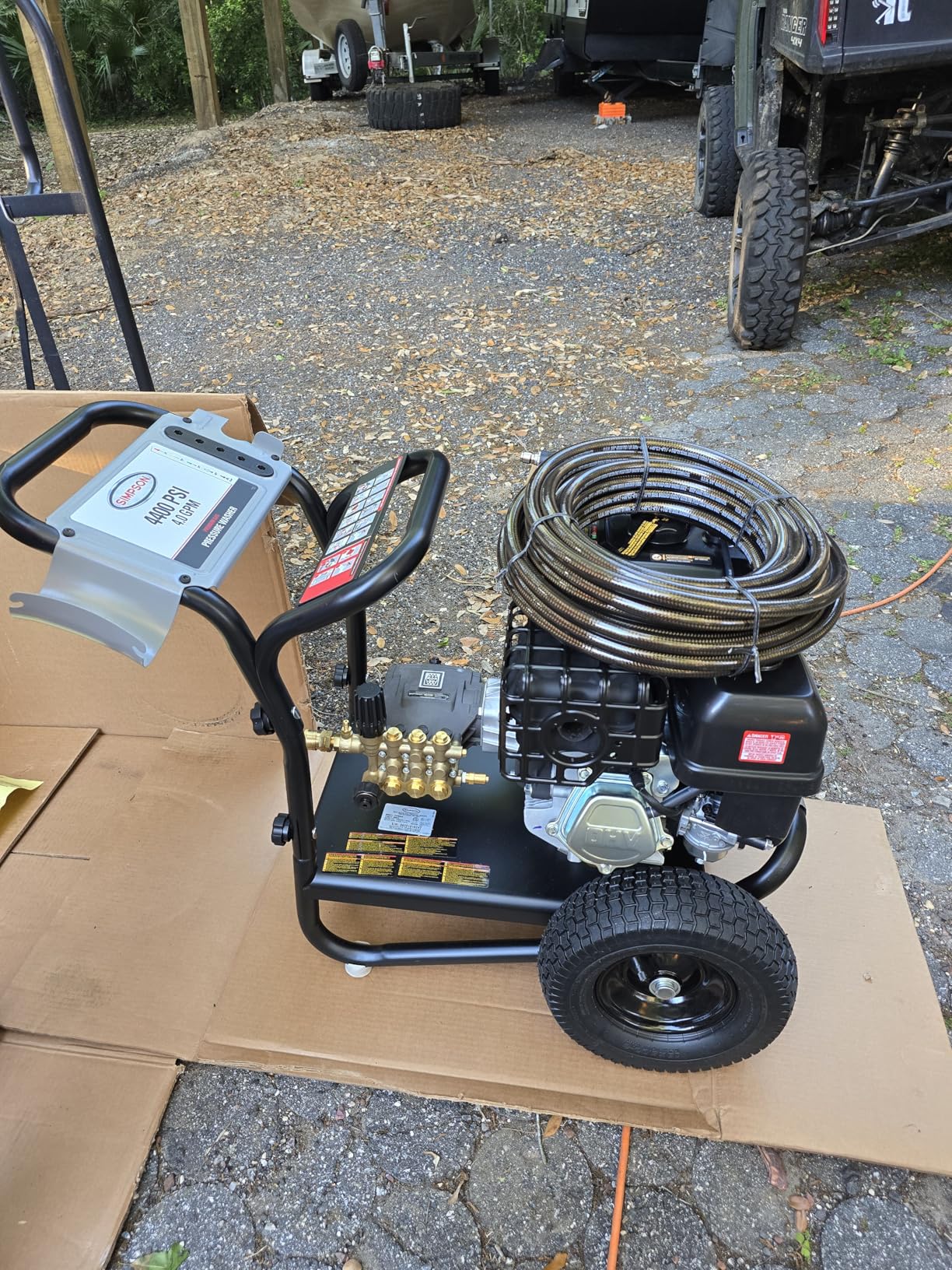
Two machines with the same PSI rating can behave completely differently in your hands. Here’s what actually matters beyond the pressure number:
Pump type
Axial cam pumps (found in the Westinghouse WPX3400 and DeWalt DXPW3400PRNB-S) are simpler, cheaper, and adequate for residential frequency. Triplex pumps (in the Simpson PS60869) run cooler, last longer under sustained use, and are the standard in commercial machines. Two machines with identical 3,400 PSI ratings can have completely different lifespans depending on pump type and how often you use the machine.
Engine quality
A Honda GX270 will outlast a generic 270cc OEM engine by years under heavy use. The Simpson’s premium pricing partly reflects the Honda engine. The Westinghouse uses a brand-built 212cc engine with solid history. The DeWalt uses an OEM-sourced 208cc engine. All three are adequate for residential use; for commercial use, the Honda is the safer long-term bet.
Hose length
A 4,000 PSI machine with a 25-foot hose is less practical for many real jobs than a 3,400 PSI machine with a 50-foot hose. Working radius matters as much as raw power for jobs like full-house siding, large driveways, or vehicle fleets.
Nozzle range and quick-connect compatibility
Most machines in this category use M22 quick-connect fittings, which means nozzles are interchangeable. Make sure the machine ships with all five standard tips (0°, 15°, 25°, 40°, soap) — anything missing means an immediate aftermarket purchase.
Soap delivery system
Onboard tank vs. siphon hose. The Westinghouse has an onboard 0.5-gallon tank. The DeWalt and Simpson use siphon systems. For frequent detergent use (vehicle washing, deck cleaning), the tank is more convenient. For rare detergent use, the siphon is fine.
The PSI rating gets you 60% of the way to a buying decision. The remaining 40% comes from these supporting specs. For a more comprehensive comparison across all of these factors, see our DeWalt vs Simpson vs Westinghouse comparison guide.
Common PSI Mistakes That Cost Buyers Money
A few patterns I see consistently in pressure washer reviews and forums:
“I bought the highest PSI I could find and it’s overkill.” This is the single most common buyer regret. People assume more PSI is always better and end up with a 4,000 PSI machine that sits in the garage because it’s too heavy and too loud for the actual work they have.
“I bought a cheap 2,000 PSI electric and it can’t handle my driveway.” The opposite mistake. Electric pressure washers in the 1,500–2,000 PSI range are fine for cars and patio furniture but genuinely inadequate for serious driveway cleaning. A 3,400 PSI gas machine cleans a driveway in 45 minutes; a 2,000 PSI electric takes three hours and leaves streaks.
“I bought 4,000 PSI for my deck and it stripped the wood.” The damage isn’t the PSI’s fault — it’s technique. But if you’re not going to learn nozzle distance and angle, lower PSI gives you a margin of safety that higher PSI doesn’t.
“I bought a 3,400 PSI machine for my pressure washing business and the pump failed in 8 months.” Residential machines aren’t built for commercial frequency. The pump types, engine ratings, and component quality differ for a reason. If you’re using the machine 10+ hours a week, 4,000 PSI commercial-grade is the right tier.
“I only looked at PSI and didn’t check GPM.” Two 3,400 PSI machines can have GPM ratings ranging from 2.3 to 2.8, which translates to 20% differences in actual cleaning speed. Always check both numbers.
Check Price on Amazon: Simpson Cleaning PS60869 PowerShot 4000 PSI Gas Pressure Washer
Frequently Asked Questions
Is 3,400 PSI enough for cleaning concrete driveways?
Yes. 3,400 PSI with 2.5–2.6 GPM handles residential concrete driveways effectively, including normal staining, mildew, and embedded dirt. Use the 25° nozzle for general cleaning and the 15° nozzle for stubborn spots. A surface cleaner attachment significantly speeds up the work.
Is 4,000 PSI too much for home use?
For most homeowners, yes. 4,000 PSI is more pressure than typical residential surfaces need, and it adds risk of damage on wood, siding, paint, and delicate materials. The weight, noise, and price premium also make it impractical for occasional residential use. Consider 4,000 PSI only if you have unusually heavy cleaning demands or commercial-scale work.
What’s the minimum PSI for stripping paint from a deck?
3,000 PSI is the practical minimum for paint stripping, and 3,400 PSI is more comfortable. Below 3,000 PSI, you’ll spend significantly more time on the same job. Above 4,000 PSI is overkill and increases the risk of gouging the wood underneath.
Can I use a 4,000 PSI machine on cars?
Technically yes, but you have to be careful. Use only the 40° nozzle, maintain 24+ inches of distance, and never aim at decals, trim, or electrical components. A 3,400 PSI or even 2,000 PSI machine is safer and more appropriate for vehicle washing.
Why do two machines with the same PSI clean differently?
Because PSI alone doesn’t determine cleaning capability. GPM (water volume), pump type, hose length, and nozzle quality all affect real-world performance. Two 3,400 PSI machines with different GPM ratings can have meaningfully different cleaning speeds.
Is higher PSI always better?
No. Higher PSI is better for sustained heavy commercial work and specific surfaces like commercial concrete, farm equipment, and graffiti removal. For residential use, going beyond 3,400 PSI typically adds cost, weight, noise, and surface damage risk without proportional cleaning improvement.
What PSI do professionals use?
Most commercial pressure washing professionals use machines in the 3,500–4,500 PSI range with 3.0–4.5 GPM. The exact spec depends on the work — soft washing for siding uses lower pressure, while concrete and equipment cleaning uses higher pressure. The Simpson PS60869 at 4,000 PSI / 3.5 GPM is a typical entry point for professional gear.
Should I buy 3,000 PSI or 3,400 PSI for the same price?
3,400 PSI, every time. The price difference between these tiers is usually small, the GPM difference is often meaningful, and the higher PSI handles a wider range of cleaning tasks. The only reason to choose 3,000 PSI is if it’s significantly cheaper and your work is consistently light-duty.
Final Verdict: Which PSI Should You Buy?
For 80% of homeowners reading this guide, 3,400 PSI is the right answer. It handles every typical residential cleaning task — driveways, fences, decks, siding, vehicles — without the weight, noise, fuel consumption, and surface damage risk of commercial-grade machines. The price is reasonable, the maintenance is manageable, and the machines in this tier (Westinghouse WPX3400, DeWalt DXPW3400PRNB-S) are built specifically for the work you have.
For the 15% of buyers with genuinely commercial-scale cleaning demands — contractors, farmers, fleet managers, mobile detailers, serious property managers — 4,000 PSI is the minimum. Anything less means slower jobs, faster wear, and pumps that aren’t built for the hours you’ll put on them. The Simpson PS60869 PowerShot is the right starting point, with the Honda GX270 engine and AAA triplex pump that justify the price for sustained heavy use.
For the remaining 5%, the answer is somewhere else entirely. Light-duty users should look at electric pressure washers in the 1,800–2,300 PSI range. California residents need CARB-compliant alternatives. Industrial users need specialized equipment beyond the scope of this guide.
The mistake to avoid is treating PSI as a single-dimension competition where bigger always wins. PSI is one spec among several, and matching the spec to your actual work is what separates a good purchase from an expensive regret.
If you’ve narrowed your decision down to specific machines, our main best gas powered pressure washer 2026 buying guide covers the top three picks across all PSI tiers with detailed comparisons by use case, budget, and convenience features.
This guide is based on hands-on testing, manufacturer specifications, and aggregated buyer feedback across thousands of verified reviews. As an Amazon Associate, we earn from qualifying purchases at no extra cost to you. Prices and availability change frequently — always verify current data on Amazon before purchasing.