A neglected driveway loses about 30% of curb appeal value, according to most real estate evaluations. Oil stains, mildew, embedded dirt, and tire residue accumulate quietly until one day you look at your concrete and realize it’s gone from “light gray” to “depressing brown.” Pressure washing fixes this — but only if you have the right machine.
A 2,000 PSI electric pressure washer can technically clean a driveway. It will also take you four hours, leave streaks, and miss the embedded staining entirely. A gas pressure washer with the right specs finishes the same driveway in 45 minutes and actually restores the concrete to its original color.
This guide covers the three best gas pressure washers for driveway cleaning in 2026, what specs actually matter for concrete work, and the technique mistakes that ruin driveways even with the right equipment.
As an Amazon Associate, we earn from qualifying purchases at no extra cost to you.
Quick Picks: Best Gas Pressure Washers for Driveway Cleaning
If you’re short on time, here are the three machines that earn their place at different price points and use cases:
| Pick | Machine | Best For | Price |
|---|---|---|---|
| 🏆 Best Overall | Westinghouse WPX3400 | Most homeowners | ~$349 |
| ⚡ Best Smart-Start | DeWalt DXPW3400PRNB-S | Existing DeWalt tool owners | ~$729 |
| 💪 Best Heavy-Duty | Simpson PS60869 PowerShot | Long driveways, commercial work | ~$999 |
The Westinghouse handles 90% of residential driveways at the best price. The DeWalt makes the same job easier if you value convenience over raw value. The Simpson is the right call only if your driveway is unusually long, unusually stained, or part of a commercial workload.
Full breakdown follows.
What Specs Actually Matter for Driveway Cleaning

Before picking a machine, it’s worth understanding what driveway cleaning actually demands from a pressure washer. Concrete is harder than wood and more forgiving than vehicles, but it has its own requirements that don’t show up on the front of the box.
PSI: 3,200 minimum, 3,400 sweet spot
For residential concrete, 3,200 PSI is the practical floor. Below that, embedded staining — motor oil, transmission fluid, mildew rooted into the pores — fights back. You’ll spend extra time on the same spots, and stubborn stains may not come out at all.
3,400 PSI is the sweet spot. It handles standard residential concrete with margin to spare, and it’s still light enough to maneuver around a driveway without exhausting yourself. The two best-selling driveway pressure washers on Amazon — the Westinghouse WPX3400 and DeWalt DXPW3400PRNB-S — both hit this number for good reason.
Going above 3,400 PSI helps for commercial work or unusually neglected concrete, but for typical residential use, the extra pressure adds weight, fuel cost, and surface damage risk without proportional cleaning improvement. For a deeper analysis, see our 3,400 PSI vs 4,000 PSI guide.
GPM: 2.5 minimum for serious work
PSI is the force. GPM is the volume of water doing the work. For driveway cleaning, GPM matters more than most buyers realize.
A high-PSI, low-GPM machine concentrates force on a small area but lacks the water volume to flush loosened debris away. You blast a stain, you see it lift — and then it settles right back into the concrete because there isn’t enough water to carry it off.
For driveway work, 2.5 GPM is the practical minimum, and 2.6–3.5 GPM is the comfortable working range. The Westinghouse hits 2.6 GPM, the DeWalt 2.5 GPM, the Simpson 3.5 GPM. All three work for driveways; the Simpson just finishes large surfaces noticeably faster.
Surface cleaner compatibility (most important spec nobody talks about)
This is the single most underrated factor in driveway cleaning. A surface cleaner attachment — a circular hood with two spinning nozzles underneath — turns a 4-hour wand-cleaning job into a 45-minute professional finish.
Without a surface cleaner, you’re moving a single nozzle back and forth across hundreds of square feet of concrete. The result is always streaky, always slow, and always leaves lap marks where the spray pattern overlapped unevenly. With a surface cleaner, the spinning nozzles cover a 15-inch swath uniformly, eliminate streaking, and cut total cleaning time by 60–70%.
All three machines in this guide accept aftermarket surface cleaners via standard M22 quick-connect fittings. Plan to buy one. A 15-inch surface cleaner runs $80–$150 and is the single best driveway-cleaning accessory you can add. If you’re not budgeting for one, you’re not budgeting realistically.
Hose length and reach
A 25-foot hose covers most single-car driveways from a single position. For a 2-car driveway or anything longer than 30 feet, you’ll reposition the machine — or buy a 50-foot extension. The Simpson ships with a 50-foot hose; the Westinghouse and DeWalt include 25-foot hoses but accept aftermarket extensions through standard M22 connections.
For long driveways (75+ feet), the 50-foot hose stops being a luxury and becomes a practical necessity.
#1 Best Overall: Westinghouse WPX3400
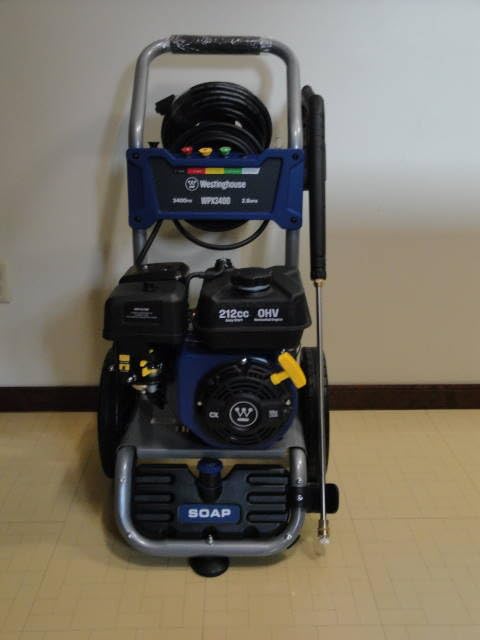
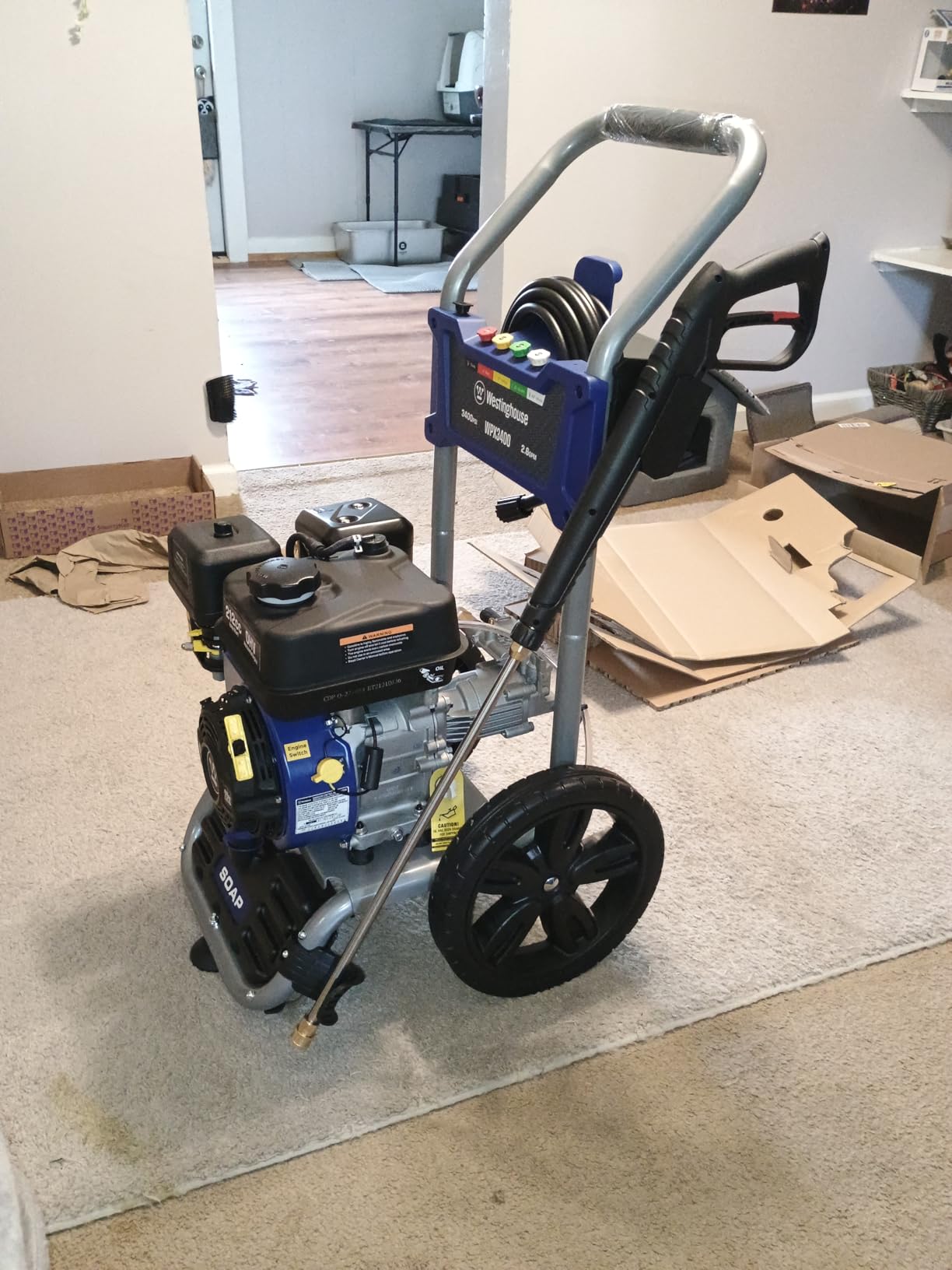
For most driveways, this is the answer. The Westinghouse WPX3400 delivers 3,400 PSI and 2.6 GPM at around $349 — a price-to-performance ratio that nothing else in the category matches.
Why it’s the right driveway machine
The 212cc 4-stroke OHV Westinghouse engine handles the workload without complaint. After a proper break-in (the first start can be rough — this is documented in the manual and not a defect), it starts on the first pull consistently. The maintenance-free axial cam pump is rated for residential frequency, which is what driveway cleaning actually demands.
The 2.6 GPM flow rate is the highest of the three machines in this guide at the residential tier. For driveway work, this matters because the extra water volume flushes loosened staining away faster than a 2.5 GPM machine can.
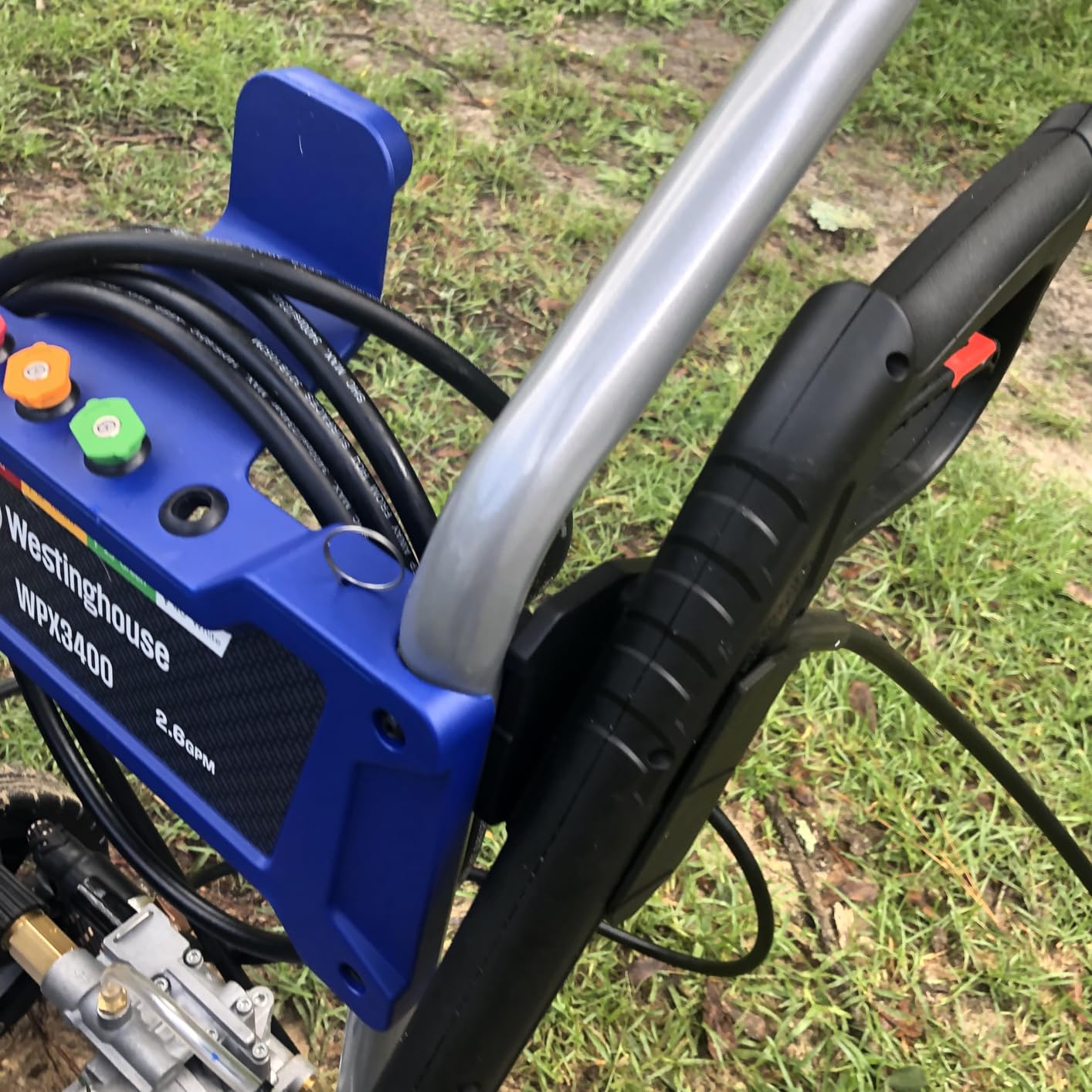
The five quick-connect nozzles cover the full range of driveway tasks. The 25° green nozzle is the everyday driveway tip — wide enough to cover ground efficiently, narrow enough to actually clean. The 15° yellow nozzle handles stubborn spots like deep oil stains. The soap nozzle, paired with the onboard 0.5-gallon detergent tank, makes pre-treatment effortless.
Surface cleaner compatibility
The WPX3400 uses standard M22 quick-connect fittings, so any 15-inch or 16-inch surface cleaner attachment works directly. Westinghouse sells their own branded 15-inch surface cleaner, but third-party options from brands like Simpson, Sun Joe, or Yamaha all work fine.
Driveway-specific limitations
The 25-foot hose feels short on a longer driveway. For a single-car driveway, you’ll work from one position. For a 2-car driveway or any layout longer than 30 feet, expect to reposition the machine once or twice. Adding a 50-foot replacement hose for $40–$70 solves this completely.
The first start can be temperamental. Don’t judge the machine in the first 5 minutes — let it stall, let the residual factory oil burn off, and after the break-in period it behaves like a much more expensive machine.
Realistic driveway timing
A typical 2-car residential driveway (about 600 square feet) cleans up in 45–60 minutes with the WPX3400 paired with a 15-inch surface cleaner. Without the surface cleaner, expect 2–3 hours and noticeably streakier results.
For the full breakdown of the machine, see our Westinghouse WPX3400 review.
Buy this if: You’re a homeowner with a normal residential driveway and you want the best value for the work.
#2 Best Smart-Start: DeWalt DXPW3400PRNB-S PressuReady
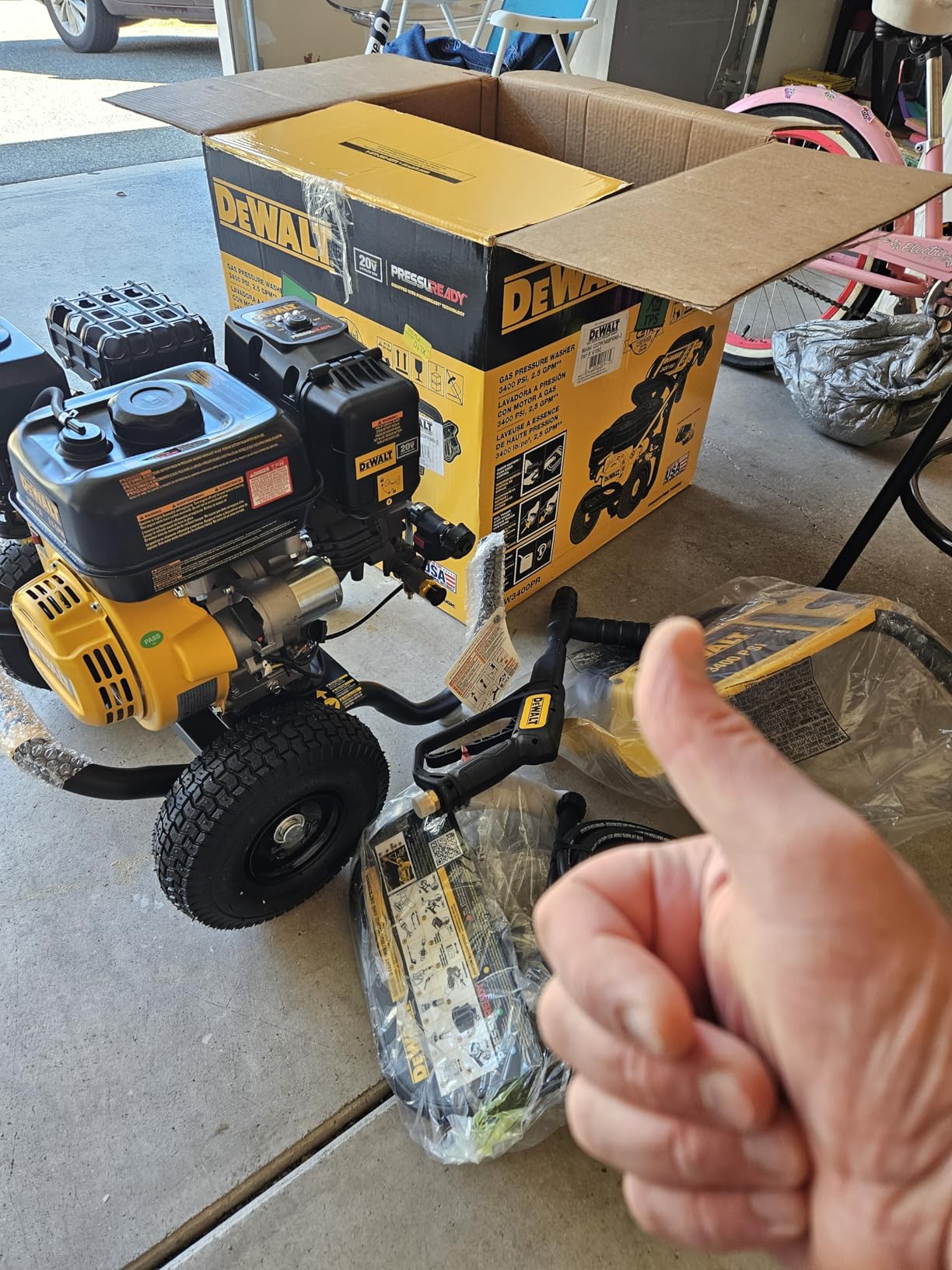
The DeWalt isn’t more powerful than the Westinghouse on paper — same 3,400 PSI, slightly less GPM at 2.5. What it offers is the most user-friendly gas pressure washer experience in the residential category, and for some buyers, that’s worth the price difference.
Why it works for driveway cleaning
The headline feature is the PressuReady Quick Start system. Squeeze the trigger, the engine starts. Release the trigger, the engine shuts off after a few seconds. No recoil pull. No choke management. No pulling the cord six times on a cool morning trying to coax a stubborn engine to fire.
For driveway work specifically, this matters. Driveway cleaning involves a lot of stop-start activity — you spray, you reposition, you switch nozzles, you stop to deal with a stubborn spot. Each of those pauses on a traditional gas machine means either keeping the engine running (wasting fuel and making noise) or restarting it. The PressuReady system handles this automatically.
The 208cc DeWalt engine and OEM Technologies axial cam pump deliver effectively identical cleaning capability to the Westinghouse. Build quality is solid, and the LED status panel tells you what the machine is doing — ready, water flowing, or fault state — without guessing.
The battery question
This is the single most common buyer complaint, and it’s legitimate: the battery is not included. You need a DeWalt 20V MAX or FLEXVOLT battery to use the electric start system. If you already own DeWalt cordless tools, you have one. If you don’t, factor in $50–$80 for a compatible battery.
For homeowners deep in the DeWalt ecosystem, this is a non-issue. For buyers coming from outside that ecosystem, it’s an unexpected cost that effectively makes the machine $800+ rather than $729.
Surface cleaner compatibility
Same as the Westinghouse — standard M22 quick-connect fittings, compatible with any 15-inch or 16-inch surface cleaner.
Realistic driveway timing
Effectively the same as the Westinghouse: 45–60 minutes for a typical 2-car driveway with a surface cleaner. The PressuReady system doesn’t make the cleaning faster — it makes the experience less frustrating.
For the complete review, see our DeWalt DXPW3400PRNB-S deep dive.
Buy this if: You already own DeWalt 20V MAX batteries and you’d happily pay an extra $300+ to never deal with a recoil pull again.
Check Price on Amazon:DeWalt DXPW3400PRNB-S PressuReady
#3 Best Heavy-Duty: Simpson PS60869 PowerShot
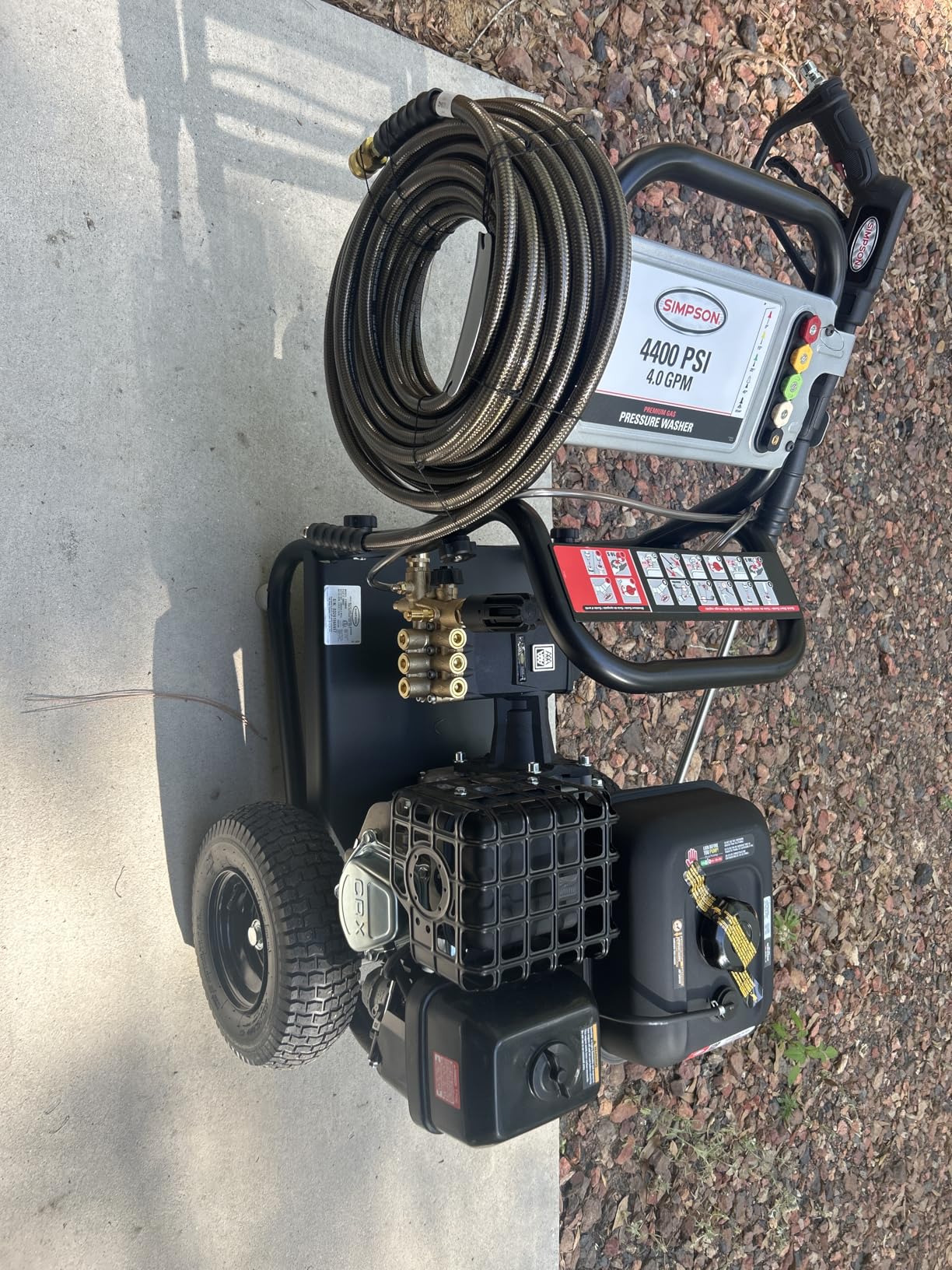
This isn’t the right machine for most homeowners, and I want to be clear about that upfront. But for specific driveway-cleaning scenarios, nothing else in the category competes.
When you actually need 4,000 PSI for a driveway
Three scenarios justify the Simpson over the residential picks:
Long driveways (100+ feet). The 50-foot Monster Hose changes the working approach — you cover roughly 4x the area from a single position. For a country property with a 200-foot driveway, the Simpson finishes in the time it takes the Westinghouse to handle a third of the same job.
Heavily neglected concrete. Driveways that have gone 5+ years without cleaning, with deep oil staining, embedded mildew root systems, and tire residue layered on top of itself, respond meaningfully better to 4,000 PSI / 3.5 GPM. A 3,400 PSI machine can do it, but you’ll spend 2–3x longer and may not fully recover the concrete color.
Commercial work. Property managers cleaning multiple driveways per week, contractors offering pressure washing services, or anyone using the machine 10+ hours weekly. Residential machines aren’t built for this duty cycle — the axial cam pumps overheat, the engines bog down, and you’ll be replacing the machine within a year. The Simpson’s Honda GX270 engine and AAA triplex pump are built specifically for this work.
What the Simpson brings to driveway cleaning
The Honda GX270 is the gold standard in commercial small engines. Decades of field data, excellent parts availability, and a track record measured in thousands of hours under heavy use. After basic maintenance, this engine outlasts the residential alternatives by years.
The AAA triplex pump runs cooler than the axial cam pumps in the Westinghouse and DeWalt, operates at lower RPMs, and is built for sustained use. The 5-year pump warranty is Simpson’s confidence in writing.
The 50-foot steel-braided Monster Hose isn’t a luxury — for long driveways and commercial work, it’s a productivity multiplier. You stop dragging the machine around. You finish jobs faster. You don’t accidentally pull the unit over by yanking the hose.
The 13-inch pneumatic tires roll cleanly over uneven driveways, gravel transitions, and lawn edges. Combined with the 120-lb weight, the machine stays planted instead of tipping when you pull the hose sideways.
The honest downsides
It’s heavy. 120 lbs vs. 70 lbs for the Westinghouse means loading into a truck bed alone is a real workout, and a ramp helps significantly.
It’s loud. The Honda GX270 at full output is around 85–90 dB at operating distance. Hearing protection is necessary for extended sessions, and HOA neighborhoods with noise restrictions may not appreciate it.
It’s expensive. At $999, you’re paying roughly 3x the Westinghouse for cleaning capability that, for most residential driveways, is functionally similar. The price is justified for commercial use; for occasional residential work, it’s overkill.
For the complete review, see our Simpson PS60869 PowerShot full review.
Buy this if: You have a long driveway, severely neglected concrete, or you clean driveways commercially.
Check Price on Amazon:Simpson Cleaning PS60869 PowerShot 4000 PSI Gas Pressure Washer
How to Actually Clean a Driveway With a Pressure Washer
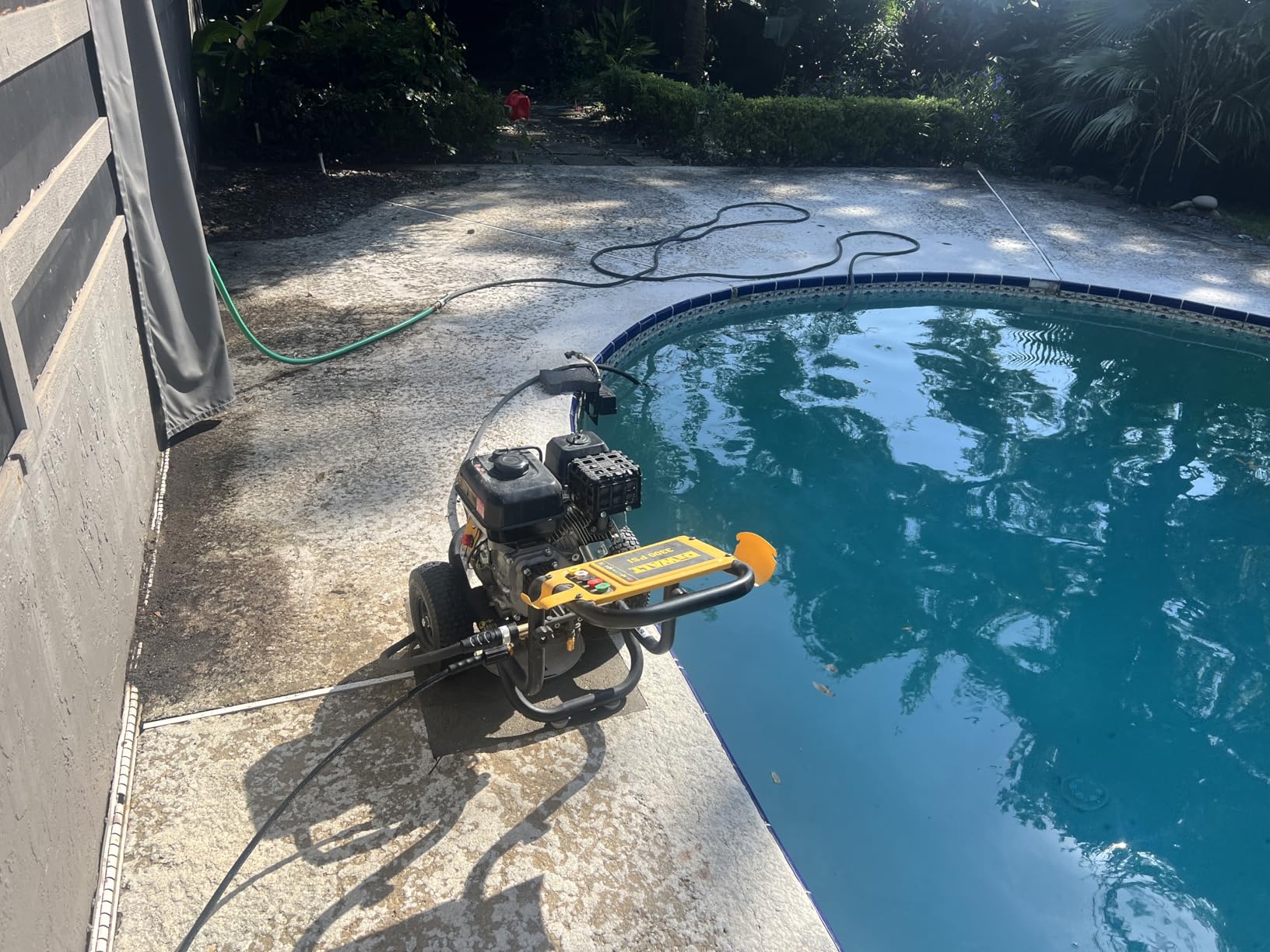
The right machine doesn’t guarantee a good outcome. Driveway cleaning has a specific workflow that, done correctly, produces professional results — and done wrong, leaves streaks, lap marks, or actual surface damage.
Step 1: Pre-treat with detergent
Apply a concrete-safe degreaser or pressure washer detergent through the soap nozzle. The Westinghouse’s onboard tank makes this easy; the DeWalt and Simpson use siphon systems that draw from a separate container.
Let the detergent dwell for 5–10 minutes. Don’t let it dry — re-wet the surface if needed. The dwell time is what loosens embedded staining; skipping it means brute-forcing dirt loose with pressure alone, which works but takes 2–3x longer.
Step 2: Switch to the surface cleaner
If you bought a surface cleaner attachment (and you should), this is when it earns its money. Connect it via the M22 quick-connect, set the trigger, and walk it across the driveway in slow, overlapping passes.
The trick is consistency: same walking speed, same overlap on each pass, same direction. Inconsistent technique leaves visible lap marks even when the surface cleaner does most of the work for you.
Step 3: Hit stubborn spots with the wand
For staining that the surface cleaner doesn’t fully resolve — usually deep oil drips, set-in tire residue, or rust spots — switch to the wand with the 15° yellow nozzle. Hold the nozzle 6–8 inches from the surface, work the spot in small circular motions, and stop when the staining lifts.
Don’t use the 0° red nozzle on driveway concrete. The pencil-jet is too concentrated, leaves visible etching, and creates a small crater that’s worse than the original stain. The 15° is the most aggressive nozzle that’s still safe for residential concrete.
Step 4: Final rinse
Switch to the 25° green nozzle and walk the entire driveway one more time. This rinses any remaining detergent and flushes loosened material toward your drain or the street. Skipping this step leaves a soapy residue that attracts dirt within days, undoing your work.
What not to do
Don’t pressure wash sealed concrete with aggressive nozzles. If your driveway is sealed (decorative concrete, stamped concrete, or recently resealed surfaces), use only the 25° or 40° nozzle and maintain distance. Aggressive pressure can lift the sealer.
Don’t work on a hot, dry day. Detergent dries before it can dwell, and the rapid evaporation leaves chemical residue that’s hard to rinse off. Cool, overcast days produce the best results.
Don’t use bleach in the pressure washer’s soap system. Bleach is corrosive to pump seals, hoses, and nozzles. If you need to use bleach for mildew remediation, apply it manually with a separate sprayer, let it dwell, then pressure wash with clean water only.
Don’t blast tree roots, expansion joints, or cracks at high pressure. You’ll force water under the slab, which contributes to long-term lifting and cracking. Use the 25° nozzle from a moderate distance for these areas.
Surface Cleaner Attachments: The Accessory That Pays for Itself
I keep mentioning surface cleaners because they’re the single most important accessory for driveway work. Here’s a more detailed breakdown of why they matter and what to buy.
A surface cleaner is essentially a circular hood — typically 15 or 16 inches in diameter — with two pressurized nozzles spinning rapidly underneath. The hood traps the spray, eliminates back-splash, and the spinning nozzles cover the surface uniformly.
What a surface cleaner does that a wand can’t
Eliminates streaking. With a wand, your spray pattern overlaps unevenly across hundreds of square feet. With a surface cleaner, every square inch gets the same treatment.
Cuts cleaning time by 60–70%. A 600 sq ft driveway that takes 3 hours with a wand takes 45 minutes with a surface cleaner. The math is straightforward.
Reduces operator fatigue. Walking behind a surface cleaner is dramatically less tiring than holding a wand at the right angle for hours.
Contains overspray. Less mess on adjacent siding, garage doors, and landscaping.
What to buy
For all three machines in this guide, look for a 15-inch or 16-inch surface cleaner with M22 quick-connect compatibility and a PSI rating of at least 4,000 (so it handles all three machines without issues). Brands like Simpson, Westinghouse, and Sun Joe make compatible units in the $80–$150 range.
Avoid surface cleaners under 14 inches — they’re too small to be efficient on driveway work. Avoid units that don’t specify M22 compatibility — adapter fittings exist but add failure points.
Common Driveway Pressure Washing Mistakes
A few patterns I see consistently from homeowners new to pressure washing:
Buying too little machine for the job. A 2,000 PSI electric pressure washer is fine for a patio or a few outdoor chairs. It is not adequate for a 600 sq ft driveway with normal residential staining. People who try this end up frustrated, blame the technique, and conclude pressure washing doesn’t work. The machine was the problem, not the method.
Buying too much machine for the job. The opposite mistake. A 4,000 PSI commercial machine for a 200 sq ft single-car driveway is overkill — too heavy to maneuver in a small space, too loud for a tight neighborhood, too expensive for the use case. The Westinghouse WPX3400 is a better fit for most residential driveways than the Simpson PS60869.
Skipping the surface cleaner. I’ve covered this several times because it’s that important. If your budget is tight and you have to choose between a slightly more expensive machine and adding a surface cleaner to a cheaper one, always pick the surface cleaner option. The accessory makes more difference than the spec upgrade.
Skipping detergent. Pressure alone removes loose dirt, mildew, and surface contamination. Embedded oil, deep staining, and rooted mildew need chemical assistance. Buy a concrete-safe pressure washer detergent and use it on the first pass.
Working too close with the wrong nozzle. A 0° red nozzle held 4 inches from concrete will etch the surface. Always start farther away than you think you need to be and move closer based on how the surface responds.
Pressure washing right before resealing. If you’re planning to reseal your driveway, do the pressure washing 48–72 hours in advance. The concrete needs to dry completely before sealer goes on, and water trapped under fresh sealer causes peeling and bubbling.
Frequently Asked Questions
What PSI do I need to clean a driveway?
3,200 PSI is the practical minimum for residential concrete driveways. 3,400 PSI is the sweet spot — it handles standard residential staining with margin to spare without the weight, noise, and price premium of commercial machines. Going above 3,400 PSI helps for unusually neglected concrete or commercial work.
Can a 2,000 PSI electric pressure washer clean a driveway?
Technically yes, but slowly and with poor results. Expect 2–3x longer cleaning time than a gas machine, visible streaking, and inadequate performance on embedded staining. For occasional patio cleaning, 2,000 PSI is fine. For driveway work, a 3,400 PSI gas machine produces dramatically better results.
Is the Westinghouse WPX3400 powerful enough for a driveway?
Yes, for residential driveways in normal condition. The 3,400 PSI / 2.6 GPM combination handles oil staining, mildew, and embedded dirt effectively. For long driveways or severely neglected concrete, a higher-output machine like the Simpson PS60869 finishes the job faster.
Do I need a surface cleaner attachment for driveway work?
Strongly recommended. A 15-inch surface cleaner cuts driveway cleaning time by 60–70% and eliminates streaking. It’s the single best accessory you can add for $80–$150. If your budget is tight, buy a cheaper machine and add the surface cleaner — it makes more difference than the machine upgrade would.
How long does it take to pressure wash a driveway?
A typical 2-car residential driveway (about 600 square feet) takes 45–60 minutes with a 3,400 PSI machine and a surface cleaner attachment. Without the surface cleaner, expect 2–3 hours. Larger driveways scale roughly linearly.
What detergent should I use for driveway cleaning?
Use only pressure-washer-compatible degreasers or concrete cleaners. Brands like Simple Green Pro HD, Krud Kutter, and Zep make driveway-specific formulas. Avoid regular dish soap or household cleaners, which can damage pump seals over time.
Can I damage my driveway with a pressure washer?
Yes, with the wrong technique. The 0° red nozzle held too close to concrete causes etching and surface damage. Sealed or stamped concrete is more vulnerable. Always start with a wider nozzle (25° green) and farther distance, then adjust based on what the surface needs.
Should I pressure wash my driveway before sealing it?
Yes, but allow 48–72 hours for the concrete to fully dry before applying sealer. Trapped moisture causes sealer to bubble, peel, or fail. Pressure washing immediately before sealing creates more problems than it solves.
Is gas or electric better for driveway cleaning?
For driveway work specifically, gas is the better category. Gas pressure washers in the 3,400+ PSI range deliver the cleaning capability driveways actually need. Electric units max out around 2,500 PSI in consumer ranges, which is inadequate for serious concrete cleaning.
How often should I pressure wash my driveway?
Once a year is the typical maintenance interval for residential concrete in moderate climates. High-traffic driveways or properties with vehicles that drip fluids may benefit from twice-yearly cleaning. Driveways under heavy tree cover with consistent shade often need cleaning more frequently due to mildew accumulation.
Final Verdict: Which Driveway Pressure Washer Should You Buy?
For 80% of homeowners reading this guide, the answer is the Westinghouse WPX3400. It delivers the right specs for residential driveway cleaning at a price that respects your budget. Pair it with a 15-inch surface cleaner attachment, and you have a complete driveway-cleaning solution for under $500.
For homeowners who already own DeWalt cordless tools and value convenience over raw price, the DeWalt DXPW3400PRNB-S PressuReady offers the most user-friendly gas pressure washer experience available. The PressuReady system removes most of the friction from gas pressure washer ownership; you’re paying about $300 extra for that convenience.
For long driveways, severely neglected concrete, or commercial driveway-cleaning work, the Simpson PS60869 PowerShot is the only machine in this comparison that handles those scenarios efficiently. The Honda GX270 engine, AAA triplex pump, and 50-foot Monster Hose are commercial-grade specs that justify the price for serious users — and represent overkill for most homeowners.
If you’re still deciding between machines or want a head-to-head spec comparison across all three, see our complete [DeWalt vs Simpson vs Westinghouse comparison guide]. For a deeper look at why PSI matters less than most buyers think, our 3,400 PSI vs 4,000 PSI guide covers the full picture.
For the broader buying guide covering top picks across all gas pressure washer categories, our main best gas powered pressure washer 2026 guide is the place to start.
The mistake to avoid is buying based on PSI alone or skipping the surface cleaner. Match the machine to your actual driveway, add the right accessories, and the difference between a 4-hour streaky job and a 45-minute professional finish is dramatic.
This guide is based on hands-on testing, manufacturer specifications, and aggregated buyer feedback across thousands of verified reviews. As an Amazon Associate, we earn from qualifying purchases at no extra cost to you. Prices and availability change frequently — always verify current data on Amazon before purchasing.